

Private companies and Party Security Provision
GHANA’S PRIVATE SECURITY REGULATORY FRAMEWORK
More than three decades after its enactment, Ghana’s regulatory framework for private security no longer reflects the realities of the country’s evolving security environment. As crime becomes more sophisticated and private security providers play an increasingly visible role in protecting lives, property, and institutions, the legal instruments meant to guide their operations remain outdated. The Police Service (Private Security Organisations) Regulations, 1992 (LI 1571), designed for a far less complex era, now constrain rather than strengthen the industry, creating gaps in oversight, accountability, and operational effectiveness. These weaknesses raise broader questions about public safety, state responsibility, and the need for comprehensive reform.
Regulatory Obsolescence and Legal Gaps
The Police Service (Private Security Organisations) Regulations 1992, LI 1571 has effectively outlived its usefulness after more than three decades, with only one amendment in 1994 relating mainly to licensing and fees. While the regulations may have served earlier needs, they no longer respond to current security challenges.
The regulations also do not provide clear operational standards. After registration, companies largely determine their own training and vetting procedures. In practice, some deploy guards with little or no training. Responsibility for reform has been contested between the state and industry actors, but regardless of this debate, oversight remains weak and fragmented. The Ministry of Interior, which licenses the industry, is overstretched and unable to conduct consistent supervision.
Licensing and Oversight Constraints
Licensing provisions do not specify the type of services companies may provide. Once licensed, Private Security Organisations (PSOs) decide independently which services to offer and may alter their focus without the knowledge of the Ministry. The regulations are also silent on foreign ownership, allowing foreign firms to compete with local operators.
The licensing process itself—requiring involvement from the Ministry of Interior, the National Intelligence Bureau, and the Ghana Police Service—is bureaucratic and time- consuming. Background checks intended to take six months often extend to several years, leading some companies to operate without approval and resulting in lost state revenue.
Although the Ministry is mandated to license both companies and employees, in practice it licenses only companies due to resource constraints. Meanwhile, a Private Security Directorate has been established within the Police Service to oversee the industry, even though this mandate is not clearly provided for in law.
Licensing and Oversight Constraints
The regulations largely confine the industry to guarding duties. In reality, the private security landscape in Ghana now includes multiple segments: manned guard services, in- house institutional security, electronic and technical security (such as alarms and CCTV), consulting and training, informal community security arrangements, and executive or close protection. Many of these areas remain outside the current regulatory framework.
Given the resource pressures already faced by the Ghana Police Service in fulfilling its constitutional responsibilities, adding the regulation of such a complex and expanding industry to its mandate has proven challenging. A dedicated regulatory authority could provide more effective oversight.
Recent Police–Industry Engagement
In May 2025, the Ghana Police Service and the Association of Private Security Organisations of Ghana (APSOG) held a strategic meeting to improve collaboration and strengthen regulation. Discussions focused on developing a unified code of conduct, standardising recruitment and training, improving operational practices, and establishing shared platforms for intelligence and crime reporting. While constructive, these initiatives do not address the broader need for comprehensive legislative reform.
Operational and Structural Challenges Facing PSOs
The private security industry continues to face multiple structural challenges. These include an outdated regulatory framework, the absence of a code of ethics or national standards, and the lack of standardised training. Financial constraints are also significant: delayed client payments, low contract rates, and rising operational costs lead to poor wages and difficult working conditions for personnel.
Low remuneration contributes to high staff turnover, low morale, and, in some cases, allegations of theft or collusion with criminal actors. Professionalism is further affected by limited training opportunities, making it difficult to attract qualified personnel. The absence of a common industry database also prevents accurate statistics and limits accountability.
Restrictions on firearms further reduce business opportunities, particularly for activities requiring armed protection, such as bullion transport or certain mining operations. Finally, limited engagement and slow responsiveness from the Ministry of Interior complicate efforts to address emerging challenges within the sector.
Taken together, outdated laws, fragmented oversight, and operational constraints have limited the effectiveness of Ghana’s private security industry. As private actors continue to supplement state security functions, the mismatch between regulation and reality underscores the need for clearer standards, stronger supervision, and modernised legal frameworks that reflect the current security environment.
PRIVATE SECURITY PROVISION AND POLITICAL PARTIES
Despite Ghana’s extensive state security architecture, political parties have often perceived existing mechanisms as insufficient to protect their political and electoral interests. Concerns frequently arise when the police are unable to respond decisively to incidents such as ballot box snatching, intimidation, or violence, particularly in perceived party strongholds. Personal safety concerns among key political figures have also increased demands for additional protection.
In response, major political parties, especially the National Democratic Congress (NDC) and the New Patriotic Party (NPP), have sought to reinforce their internal security arrangements. This has contributed to the emergence of vigilante groups acting as informal or private security operatives for parties.
These groups have raised concerns among security professionals due to their irregular status, their potential to cause harm, and the risks associated with their support base. Ghana has no formally prescribed internal party security structure; political parties are registered as civil entities and are expected to operate within the law, with members enjoying the same constitutional security protections as other citizens. Within this context, political party security engagement can be understood at two levels: strategic and operational.
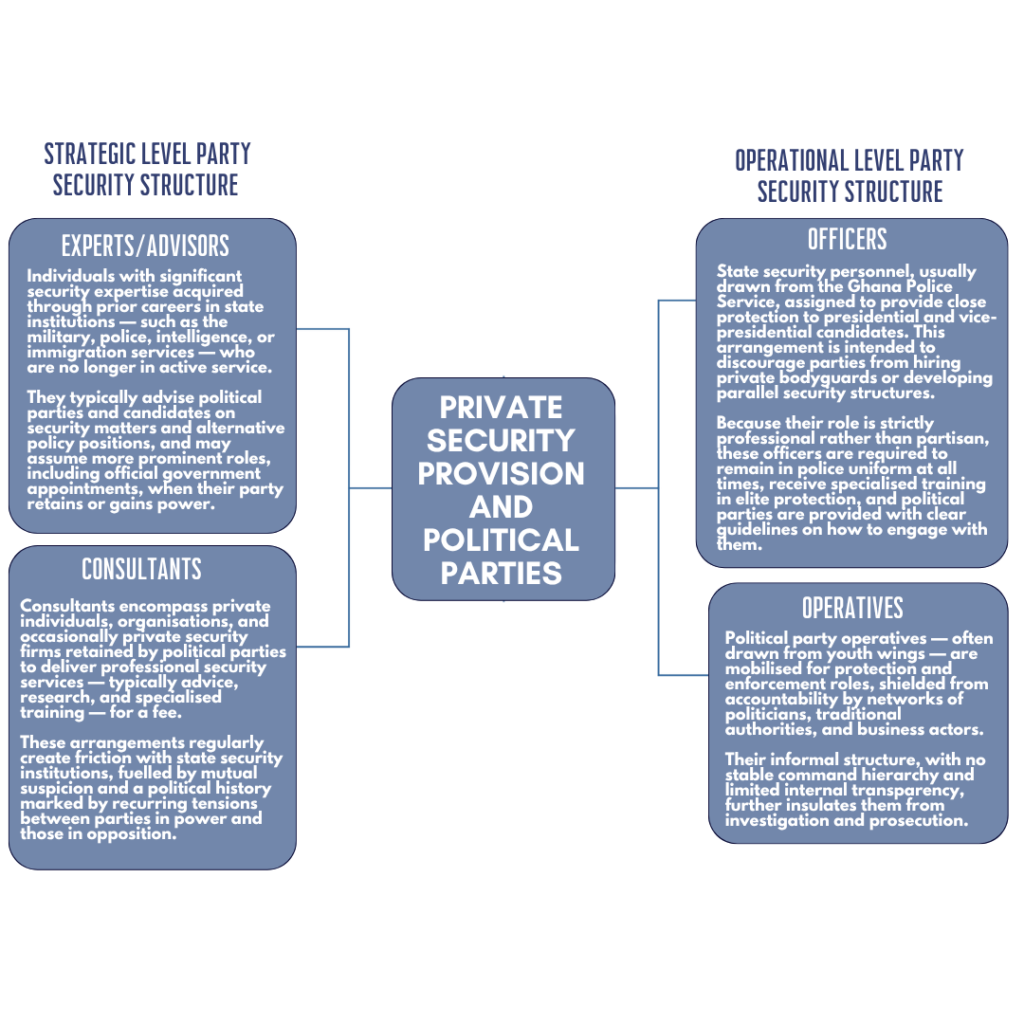
Strategic Level Party Security Structure
At the strategic level, two main categories of political party security actors can be identified.
- Experts/Advisors
These are individuals with significant security expertise, often acquired through previous professional careers in state institutions such as the military, police, intelligence, or immigration services, but who are no longer in active service. They typically provide advice to political parties and candidates on security matters, including alternative policy positions.
Those affiliated with opposition parties may face close monitoring by state security agencies, as their activities are sometimes viewed as matters of national security interest. For example, in September 2008, the New Patriotic Party administration barred former President Jerry John Rawlings and seven former military and police commanders from all military and security installations following a meeting at his residence that reportedly raised national security concerns. The then-opposition National Democratic Congress described the move as an election-related tactic intended to create fear and intimidation.
Beyond advisory functions, these individuals may assume more prominent roles and, when their party retains or gains power, may be appointed to official government positions.
- Consultants
Consultants include private individuals and organisations—sometimes private security companies—that provide analytical and professional security services to political parties, typically on a fee-for-service basis. Their support often covers advice, research, and specialised training.
A well-known example is the “SA 3” case. In March 2016, state security officials arrested three South African security consultants who had reportedly been invited to provide specialised security training to members of the New Patriotic Party security detail.
Such engagements frequently generate tension between party security arrangements and state security institutions, often driven by suspicion and shaped by Ghana’s political history, which has at times been marked by strained relations between ruling and opposition parties. At the same time, consultants may have limited partisan affiliation, as their primary motivation is typically commercial rather than political.
Operational Level Party Security Structure
- Officers
Officers are state security personnel, usually drawn from the Ghana Police Service, who are assigned to provide close protection to political parties’ presidential and vice- presidential candidates. This arrangement is intended to discourage parties from hiring private bodyguards or creating parallel security structures.
Because their role is strictly professional rather than partisan, these officers are required to remain in police uniform at all times. They receive specialised training in elite protection, and political parties are provided with clear guidelines on how to engage with them.
During elections, state-provided security details have been assigned to parties including the New Patriotic Party, the National Democratic Congress, the Independent People’s Party, the Ghana Freedom Party, and the All People’s Congress
- Operatives
Operatives are individuals or groups, often drawn from youth wings, who are recruited or mobilised as affiliates or members of political parties to perform security-related functions. They may demonstrate strong personal loyalty to party leadership and possess physical attributes or skills suited to protection or enforcement roles.
These actors are frequently described in the media and by security professionals as “macho men,” bodyguards, private security forces, or vigilante groups operating within party structures.
In recent years, notable examples have included the Bolga Bulldogs, Azorka Boys, Kandahar Boys, and Invincible Forces. Their proliferation seems to have evolved along with the increased intra- and inter-party political and electioneering rivalries\, which have placed extra obligations on candidates and parties to provide extra security beyond what the state can provide to safeguard their political interests.
Operatives often perform a dual role. On one hand, they advance the personal or factional interests of their patrons within political parties; on the other, they seek to protect the electoral fortunes of their parties during general elections. This dynamic reflects a broader challenge in emerging democracies such as Ghana, where competing loyalties may exist between political patrons, parties, and the state, including among some members of the security sector.
Their informal nature typically means there is no stable hierarchy of command, and only a small number of party functionaries may know their true identities or organisational structures. In terms of recruitment, some analyses suggest that deprived urban areas, including Zongo communities and northern cities such as Tamale, have become common recruitment grounds. These groups are often mobilised to provide security at party activities such as primaries, congresses, rallies, and demonstrations. However, they have also been associated with disruptive practices, including ballot box snatching, intimidation of voters, and interference with electoral processes.
Until the 2020 elections, the proliferation of such groups included some armed elements, increasing their capacity to cause violence during party functions and elections. Even after the introduction of the anti-vigilantism law in 2019 and the reduction of visible vigilante activities, these groups were still associated with intimidation, assaults on opponents, destruction or seizure of electoral materials, attacks on electoral officials, vandalism of registration centres, forcible occupation of public offices, and resistance to new government appointments. Reported incidents linked to by-elections and reruns between 2000 and 2025 resulted in at least ten deaths and more than sixty injuries.
These groups do not operate in isolation. They are often believed to benefit from political and social networks that shield them from law enforcement. Support linked to local political interests, succession disputes, chieftaincy matters, and land issues may provide them with protection from traditional authorities, politicians, and business actors, contributing in some cases to limited investigation or prosecution when violations occur.
Although election security falls under the mandate of the election security task force, the Ghana Police Service plays the lead operational role. As a result, it has been at the forefront of engaging political parties to address the problem of vigilante groups.
The reduced visibility of such groups during the 2020 and 2024 elections may suggest that many were disbanded following the anti-vigilantism legislation introduced in 2019. However, incidents of violence during the Ayawaso West Wuogon by-election, the 2020 general elections, and the 2025 rerun in Ablekuma North indicate that, even where formal groups have diminished, practices associated with vigilantism continue to pose a threat to electoral security in Ghana.