Ghana has remained relatively insulated from direct violent extremist attacks; however, spillover risks from the Sahel, regional political instability, porous borders, governance deficits, and persistent socioeconomic inequalities continue to increase the country’s vulnerability.
In response, the government adopted the National Framework for Preventing and Countering Violent Extremism and Terrorism (NAFPCVET) and implemented multi-level initiatives supported by security institutions, civil society organisations, development partners, and community actors. These measures include strengthened border patrols and surveillance through “Operation Conquered Fist,” the establishment of Forward Operating Bases in vulnerable areas, capacity-building programmes, public awareness campaigns, and enhanced community engagement, including interfaith dialogue. They also encompass targeted economic development initiatives for northern regions and initial support to the pastoral sector through restructuring and dialogue with pastoral communities, particularly Fulani groups.
At the regional level, Ghana promotes a coordinated and solidarity-based approach to counter terrorism and drivers of violent extremism, notably through its leadership in establishing the Accra Initiative, a subregional security cooperation framework. However, the Initiative’s effectiveness has been significantly undermined by the growing tensions between ECOWAS and the military regimes that have taken power across the Sahel. Domestically, decentralisation and administrative reorganisation have enabled a denser territorial security network, while specialized counterterrorism and special forces units have been redeployed to northern border areas, supported by enhanced surveillance and border control capacities.
Preventing Violent Extremism (PVE) refers to policies, initiatives and measures intended at dissuading groups and individuals from engaging in violent extremist acts. PVE focuses on prevention making use of human-security oriented measures to prevent radicalization whilst ensuring social cohesion and trustful relations between communities and state actors through community dialogues and engagements.
This differs from Countering Violent Extremism (CVE), which traditionally refers tonmeasures and initiatives that are directed at disrupting planned attacks and recruitment activities. It utilizes security measures aimed at individuals and groups that are already in the web of radicalization.
Preventing and Countering Violent Extremism (PCVE) is therefore a wholistic approach that integrates both preventive (PVE) and countering (CVE) measures to address the whole gamut of the threat from conditions that lead to radicalization to the reality of extremist violence.
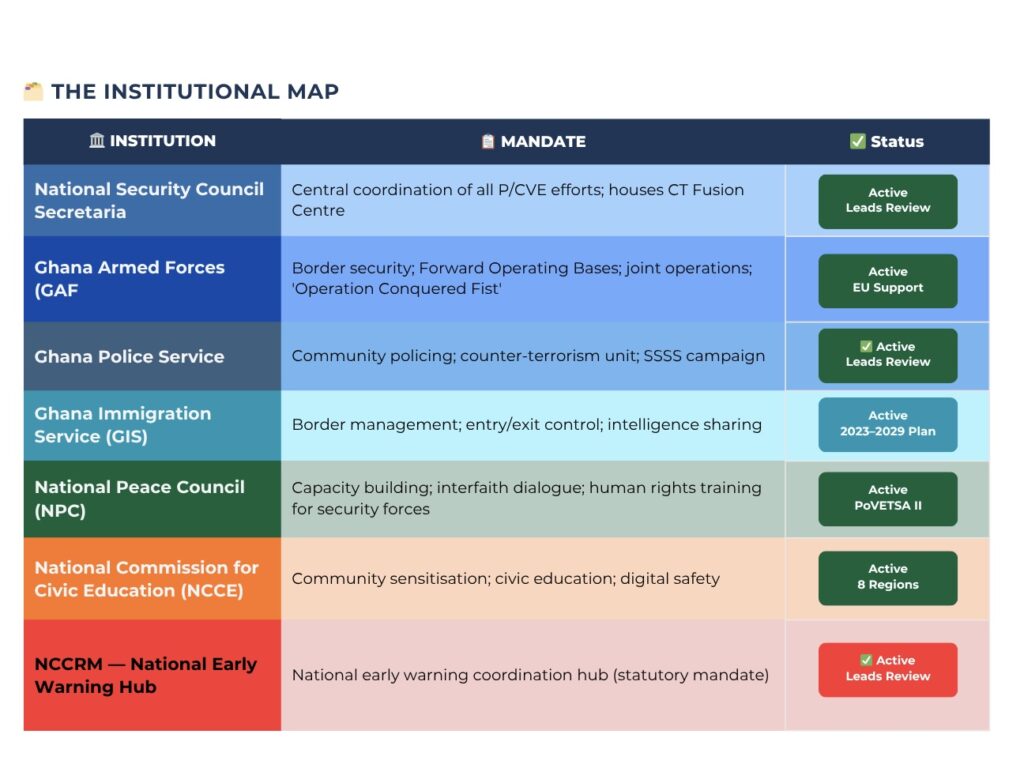
Ghana has a structured architecture for preventing and countering violent extremism. The National Security Council Secretariat coordinates governments P/CVE efforts with other security and intelligence agencies, Ministries, Metropolitan, Municipal, and District Assemblies (MMDAs), the National Peace Council (NPC), and the National Commission Civic Education (NCCE).
Ghana’s National Security Council Secretariat, predating the former the Ministry of National Security, serves as the central body for managing current, emerging, and future security threats. In 2019, it developed the National Framework for Preventing and Countering Violent Extremism and Terrorism (NAFPCVET) under the direction of the National Security Council, structured around four pillars:
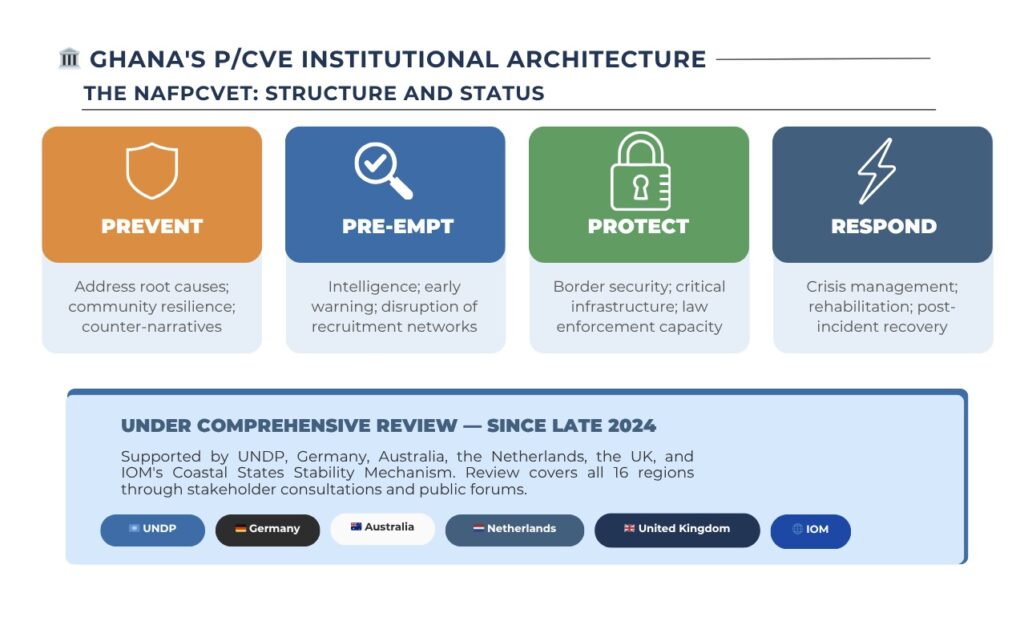
Implementation is led by the Counter-Terrorism Fusion Centre, which coordinates joint security operations, border patrols, capacity building, community engagement, sensitization activities, and quick impact projects, alongside education and awareness efforts through the “See Something, Say Something” campaign to strengthen public vigilance and information sharing.
Since late 2024, the Centre has led a nationwide review of the framework through stakeholder consultations, supported by partners including the UNDP, Germany, Australia, Netherlands, United Kingdom, and the Coastal States Stability Mechanism (CSSM) of the International Organisation for Migration (IOM), to align with international standards.
Implementation is further supported by complementary policies and legislation, including:
“See Something Say Something” (SSSS) is a public awareness campaign led by the Ministry for National Security, now integrated into the Ministry of the Interior, and forms part of the prevention and pre-emption pillars of the National Framework for Preventing and Countering Violent Extremism and Terrorism (NAFPCVET). It aims to sensitise citizens to security threats, encourage vigilance, and promote the reporting of suspicious behaviour as an early warning and deterrence mechanism against banditry, violence, and potential terrorist activity.
The initiative strengthens community participation through outreach activities, including engagements in basic schools across districts in the Greater Accra Region, where students receive age-appropriate training to build civic responsibility and security awareness. Reported outcomes include arrests of suspected criminals, deportations, and the disruption of sleeper cells, particularly in northern and border communities. However, operational challenges persist, including cumbersome reporting procedures and limited infrastructure in remote areas, which delay alerts and response. These constraints underscore the need for stronger response and recovery systems and improved monitoring capacities.
The Ghana Police Service is responsible for maintaining internal security, law and order, crime prevention, public safety, and protection of life and property. As part of this mandate, it operates a counter-terrorism unit to address threats of VET and promotes a community policing strategy that strengthens trust and cooperation between citizens and security agencies.
Capacity-building efforts support this work. The EU-funded PEACE PROTECT project trained senior officers from northern border regions in community policing and preventing violent extremism, while the National Peace Council has provided training on human rights, early warning systems, and social accountability. In partnership with Catholic Relief Services, additional officers have been trained to prevent VET at the regional level.
Police also conduct public awareness campaigns, collaborate with community leaders and watchdog groups, and contribute to local coordination and early warning mechanisms through participation in the NAFPCVET review process led by the National Security Council Secretariat.
The Ghana Armed Forces (GAF), mandated by the 1992 Constitution and the Armed Forces Act of 1962 (Act 105), is responsible for defending Ghana’s sovereignty and territorial integrity, supporting civil authorities, maintaining internal security, protecting critical infrastructure, contributing to national development, and participating in peacekeeping missions. Comprising the Army, Navy, and Air Force, the GAF plays a central role in countering VET threats, including joint cross-border operations under the Accra Initiative and domestic deployments such as Operation Conquered Fist and Forward Operating Bases in northern border regions.
The GAF has strengthened preparedness through specialised training and exercises, enhanced interoperability, and logistical support from the European Union. Additional capacity-building efforts have been conducted with the National Peace Council, Catholic Relief Services, United Nations Development Programme, and the Kofi Annan International Peacekeeping Training Centre, as well as through internal military institutions, to enhance skills in counter-terrorism, community engagement, and prevention of radicalisation.
The Ghana Immigration Service (GIS) regulates and monitors the entry, residence, employment, and exit of foreigners, while preventing irregular migration, detecting threats at entry points, and combating transnational organised crime. In addressing VET, the GIS strengthens border security through patrols, surveillance of entry and exit points, community sensitization, and intelligence sharing with national and international partners.
Since the adoption of the NAFPCVET, the GIS has expanded cooperation with partners such as the European Union and received logistical support from Germany to enhance operational capacity and officer safety. Officers have also benefited from training by the National Peace Council and Catholic Relief Services, and have participated in stakeholder consultations led by the Counter-Terrorism Fusion Centre. With support from the International Centre for Migration Policy Development, the GIS has further adopted a 2023–2029 Strategic Plan focused on risk analysis, inter-agency coordination, and technology use to strengthen border and migration management and counter security threats such as VET.
The National Peace Council (NPC), established by Act 818 in 2011, leads the development, coordination, and capacity building of mechanisms to prevent, manage, and resolve conflicts in Ghana, making it a central component of the country’s P/CVE architecture. Working with partners including Catholic Relief Services, United Nations Development Programme, Kofi Annan International Peacekeeping Training Centre, and West Africa Network for Peacebuilding, it provides training to community actors and security agencies to strengthen knowledge of VET risks and response capacities.
The Council also conducts nationwide education and awareness campaigns, particularly in northern border areas, promotes vigilance and reporting of suspicious activities, and supports initiatives such as PoVETA II to build trust between civilians and security forces while integrating human rights into P/CVE efforts. Through dialogue, peace education, and the promotion of religious tolerance, rule of law, and social cohesion, the NPC contributes to reducing conflict risks and strengthening sustainable peace.
The National Commission for Civic Education (NCCE) promotes public peace education, awareness creation, and capacity building to strengthen civic responsibility and citizen participation in P/CVE[EH1] . Through its regional and district offices, particularly in northern Ghana, it conducts sensitization campaigns on violent extremism, using tools such as cinema vans to reach border communities and promote social cohesion.
With support from the European Union, the NCCE implemented the “Preventing and Containing of Violent Extremism” project across five northern regions, combining research, community and youth engagement, and early warning and prevention mechanisms. It has also expanded outreach on digital safety and countering misinformation, organised civic dialogues on security, accountability, and rule of law, and established civic education clubs nationwide to strengthen youth participation in democratic governance and national stability. [EH1]Though it should be understood (to avoid possible misunderstanding) that this is only one (and relatively recent) part of the broad mandate of the NCCE, reaching back to its origins in the Centre for Civic Education in the 1960s.
Ghana has established a National Centre for Coordination of Early Warning and Response Mechanism (NCCRM) that coordinates and manages early warning systems and response mechanisms to security threats in the country. The Centre is helping to gather, analyse and report early warning signals of threats of violent extremism and terrorism (VET) for timely response by security agencies.
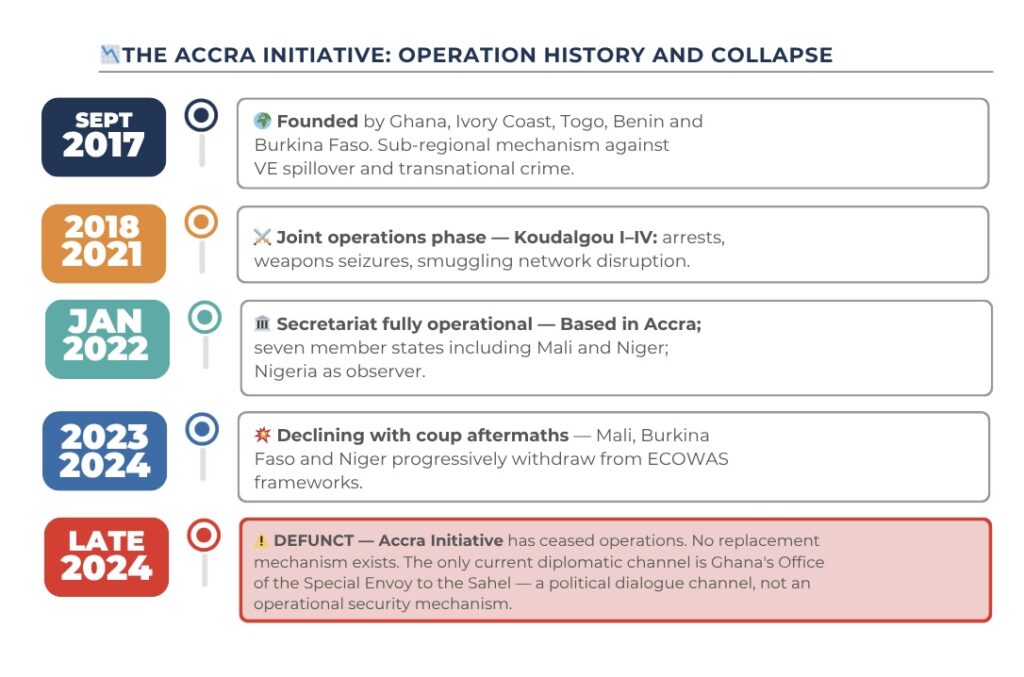
Ghana was a founding member of the Accra Initiative (AI), a subregional security cooperation mechanism launched in 2017 with Benin, Togo, Côte d’Ivoire, and Burkina Faso, later joined by Niger and Mali, with Nigeria as an observer. Conceived as a homegrown and “stopgap” response to shared insecurity, the Initiative aimed to prevent the southward spillover of violent extremism from the Sahel and combat transnational organised crime in border areas. Its cooperation framework rested on three pillars: intelligence and information sharing, joint cross-border operations, and the training of security and intelligence personnel.
Through this platform, Ghana enhanced coordination with neighbouring states, strengthened intelligence exchange, and participated in joint military deployments, notably the Koudalgou I–IV operations (2018–2021), which led to arrests, weapons seizures, and the disruption of smuggling routes and extremist support networks. These efforts improved surveillance and control of key border zones and helped counter illicit trafficking in arms, fuel, fertilizer, motorbikes, vehicles, grains, and other goods linked to criminal and extremist networks.
Despite these gains, the Initiative remained only partially institutionalised, with activities often ad hoc and short term. Its effectiveness was constrained by uneven capacities among member states, limited interoperability and intelligence-sharing systems, funding gaps, and the absence of a permanent command structure. Since late 2024, operations have ceased following political instability and coups in several member states.
Yet despite considerations on its dysfunctionality, there are efforts by the current Ghanaian government to restructure and retool Accra Initiative in a different mode or even dissolve it altogether and replace it with a new platform that will be inclusive of the AES countries. It is uncertain in what form the new entity would take but President Dramani Mahama is expected to outdoor the new entity during 2026.
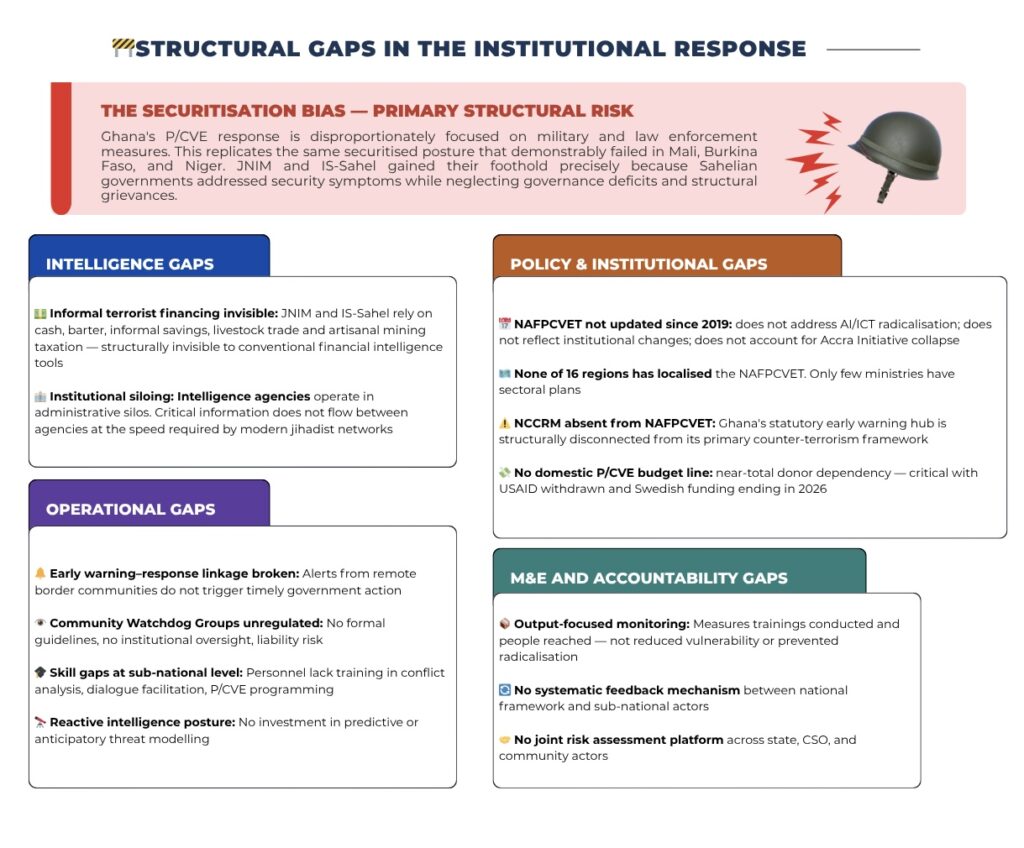
Despite these efforts, significant gaps continue to undermine the effectiveness and resilience of the national preventing and countering violent extremism (P/CVE) architecture.
Ghana’s National Framework for Preventing and Countering Violent Extremism and Terrorism (NAFPCVET), the country’s main strategic blueprint against VET, is currently under comprehensive review. While multiple state institutions — including the National Security Council Secretariat, Ghana Armed Forces, Ghana Police Service, and Ghana Immigration Service — as well as local authorities, civil society, and development partners are involved, coordination remains weak, with no strong central mechanism to harmonise roles, lead multi- stakeholder engagement, or prevent duplication.
Implementation is further constrained by limited decentralisation. None of the 16 regions has developed a context-specific regional strategy, and few ministries or agencies have aligned sectoral or institutional plans with the framework, reducing local ownership and adaptation, particularly in high-risk border areas. Moreover, many P/CVE interventions remain project- based and externally funded rather than institutionalised within permanent state systems, creating reliance on short-term donor support and potentially undermining long-term sustainability if external funding declines.
Despite efforts from state actors, civil society organizations (CSOs), and community stakeholder, the implementation of Ghana’s P/CVE interventions has been constrained by weakly coordinated monitoring and evaluation systems that do not effectively align national policies with local realities and resilience mechanisms. Current approaches focus mainly on quantitative indicators—such as the number of projects delivered, people or institutions trained, and areas covered—rather than assessing meaningful impact or strengthening community resilience. Strengthening effectiveness will require the establishment of inter- agency coordination platforms at national, regional, and district levels.