

Indigenous Conflict Resolution and the Gendered Role of Akan Queenmothers in Ghana’s Peace and Security Landscape
Indigenous conflict resolution methods often prioritize restorative justice, focusing on community harmony and social cohesion rather than punishment or individual gain. These approaches rely on customary norms, ritual practices, dialogue, and negotiation. Mediation is typically conducted by neutral and respected community figures such as elders, customary leaders, chiefs, queens, and other titled authorities, who act as moral guardians and custodians of social order.
The primary objective of these systems is preventive conflict, repair harm, preserve intergenerational relationships, and avoid tensions that could disrupt families or escalate into broader conflict. As a result, solutions emphasize reconciliation rather than punitive measures.
WOMEN IN INDIGENOUS CONFLICT RESOLUTION
Women play a central role in these processes. Their positions within families and across lineages; as wives, mothers, sisters, and aunts, often place them in a strong position to mediate disputes within households, between clans, and across communities. They are particularly involved in resolving marital disagreements, land access and use issues, and inter-ethnic conflicts.
Among the Akan of Ghana, the Ohemaa is responsible for settling domestic disputes and serves as the main advisor to chiefs. In market spaces, market queens represent women’s interests both in traditional courts and district assembly meetings (constituting a form of legal hybridity). They have also contributed to peace negotiations, participated in disarmament efforts, and supported campaigns promoting women’s political leadership. In this way, traditional justice mechanisms can complement formal judicial systems, particularly in responding to the needs of victims, including those affected by sexual violence during conflicts.
This hybrid form of governance has proven essential for maintaining peace and order, particularly in non-urban communities where the reach of the state remains weak.
QUEENMOTHERS
The Ghanaian chieftaincy landscape is structured around two main systems of succession and inheritance: patrilineal and matrilineal.
Acephalous societies generally follow patrilineal systems, while more centralized societies, particularly among the Akan, practice matrilineal inheritance. Even within matrilineal systems, however, women often struggle for visibility, as chiefly authority is frequently expressed through a male lens.
Women’s leadership is nonetheless present across both systems. Among the Dagbon, female chiefs have historically ruled towns and worked with male councillors and servants. At the same time, socio-cultural and religious norms may restrict women’s participation in formal peace spaces, leading many to engage through informal conflict resolution and peacebuilding efforts, as observed among Dagbon and Grusi women.
Within matrilineal Akan societies, women form an integral part of the political structure. They participate in legislative and judicial councils and contribute directly to decision-making. The position of the Ohemaa (Queenmother) reflects women’s responsibility for ensuring the continuity of the matrilineage and places them at the centre of political authority.
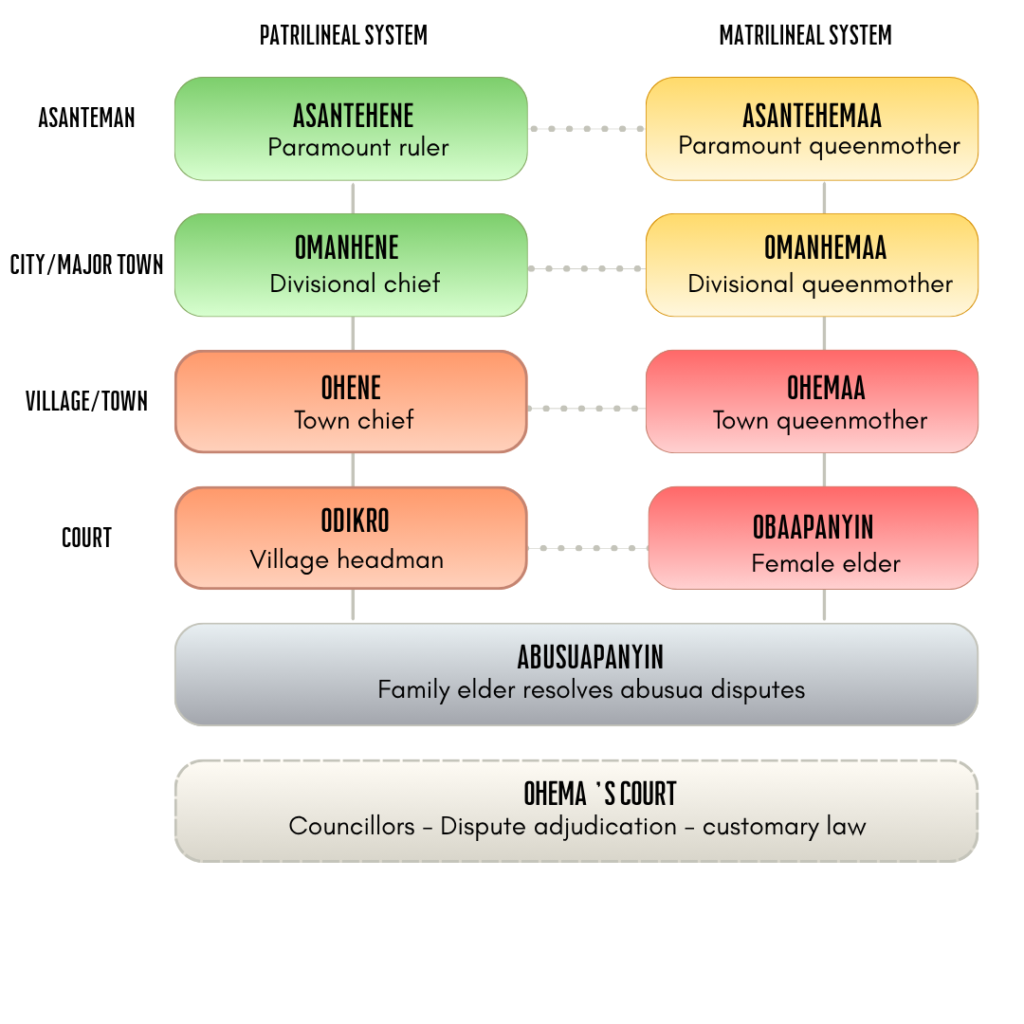
Governance operates through a layered system. At the family level (abusua), disputes are addressed by the abusuapanyin. Matters may then move to the odikro and obaapanyin, leaders of small towns or villages, before reaching the Ohene and Ohemaa, who govern major towns. In Asante, the Omanhene or Omanhemaa answer to the Asantehene and Asantehemaa.
In this structure, the Asante queenmother is the female counterpart of the ruler of a village or town in Asanteman. The Asante practice what has been described as a dual gender system, in which stools are hereditary and authority operates in parallel: the Ohene and the Ohemaa hold complementary roles rather than hierarchical ones. Female rulers of lower status are referred to as Obaapanyin (female elder). Asante Queenmothers function as female monarchs within a hierarchical yet centralized political system.
Queenmothers carry formal responsibilities that include nominating and installing chiefs, performing ritual duties, serving as chief advisors, and participating in councils and customary courts. Each Ohemaa maintains her own court, supported by male and female councillors, where domestic and community disputes are adjudicated. Through these political and judicial roles, and through the application of indigenous conflict resolution mechanisms, the Queenmother’s court contributes directly to peace and security within the wider Ghanaian landscape.
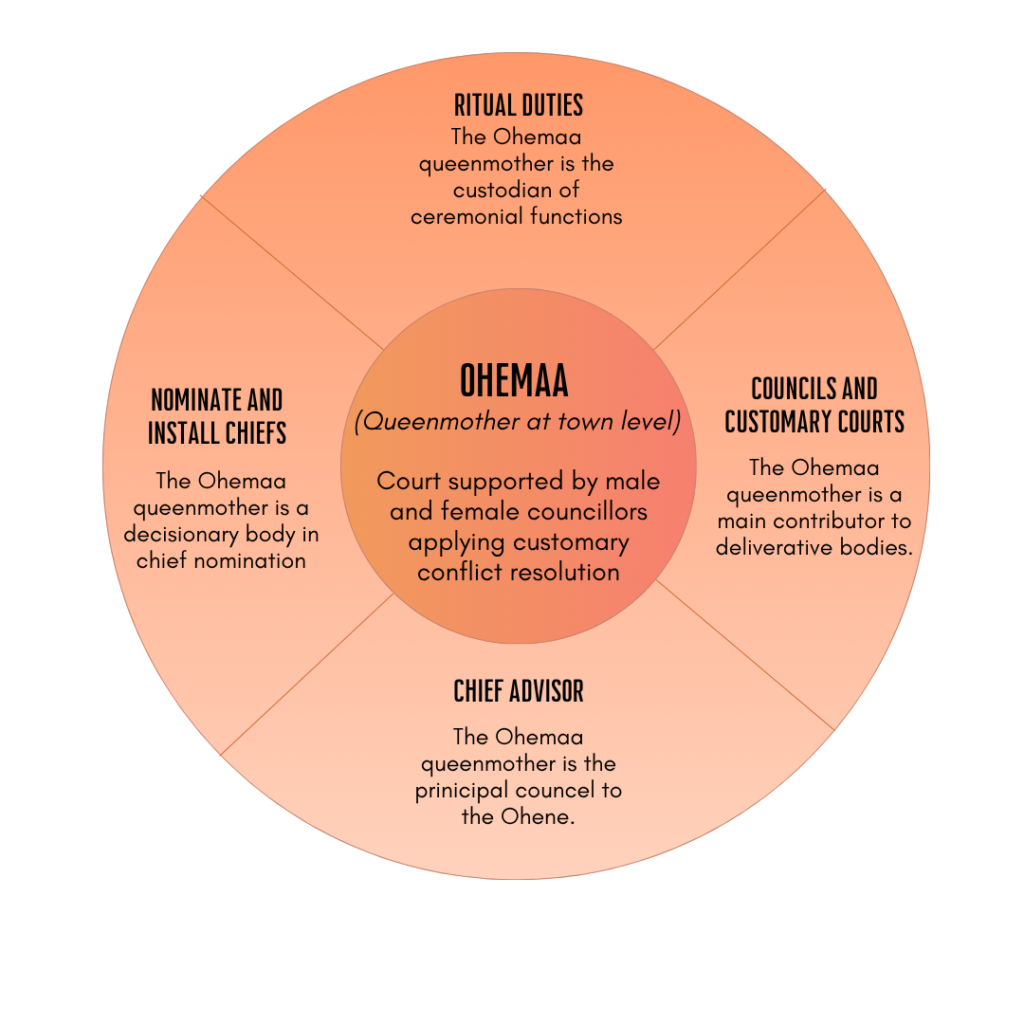
POLITICAL AND JUDICIAL ROLES OF AKAN QUEENMOTHER
In the Ashanti political system, authority is symbolized through two stools: one occupied by the senior woman and the other by her male kinsman. This arrangement reflects a dual political structure in which the presence of the Ohemaa (Queenmother) represents a traditional institution that provides women with a recognized space in governance and an avenue for their concerns to be heard. Despite this dual authority, the male stool generally receives greater political recognition.
As the senior female of the royal matrilineage, the Ohemaa holds a central constitutional role in leadership selection. She is responsible for nominating the Ohene (chief) from among eligible male candidates and overseeing the enstoolment process. This selection is conducted through consultation and discussion with clan members, and the chief’s position ultimately depends on the queenmother’s nomination together with acceptance by kingmakers.
Beyond her role in succession, the Ohemaa serves as the representative and guardian of women within the community. She addresses matters relating to women’s welfare and adjudicates domestic disputes, including issues of marriage and spousal maintenance, through her court. Her authority is also reflected in her position as the traditional owner of market spaces in Asanteman, further reinforcing her social and economic responsibilities within the political system.
THE ASANTEHEMAA’S COURT
Within the Asante chieftaincy structure, the Ohemaa (Queenmother) is an automatic member of the Ohene’s court and council. She participates directly in both judicial and legislative processes and serves as the chief advisor to the Ohene. As part of this role, the Ohene is expected to consult his councillors, including the Ohemaa, before making major decisions that affect the state.
A central aspect of the Ohemaa’s authority is dispute settlement. She maintains her own court, and similar systems are replicated throughout Asante. As head of the royal matrilineage, she uses this space to resolve conflicts among her attendants, between the Ohene and his wives, and within the royal family.
The Ohemaa’s court includes both male and female stool holders, notably Adikro and Mbaa Panyinfuo from smaller communities under her jurisdiction. She determines who serves as officials in her court and, like the Ohene, appoints her own Ntam Akyeame and members of a judicial panel. While the structure generally parallels that of the Ohene’s court, there are some variations in composition and number. In the case of the Asantehemaa’s court, additional functionaries are included, and she serves as the chief arbitrator.
Access to the court is not restricted by sex. However, because the Ohemaa is recognized as a defender of women’s rights under Asante customary law and as the traditional owner of market spaces in Asanteman, many of the cases brought before her involve women. Her ritual responsibilities, including ensuring food provision for religious observances, maintain close ties with market and commodity queens. These women coordinate the supply of essential goods for ritual days and bring disputes to her for resolution. Through these combined judicial, social, and ritual functions, the Ohemaa plays a central role in governance and community mediation.
GENDERED ACCESS TO THE COURT
Access to justice requires that all parties receive a fair hearing in accordance with the principles of natural justice. In practice, however, access is often limited for marginalized groups, including the poor, children, youth, women, persons with disabilities, minorities, and indigenous communities.
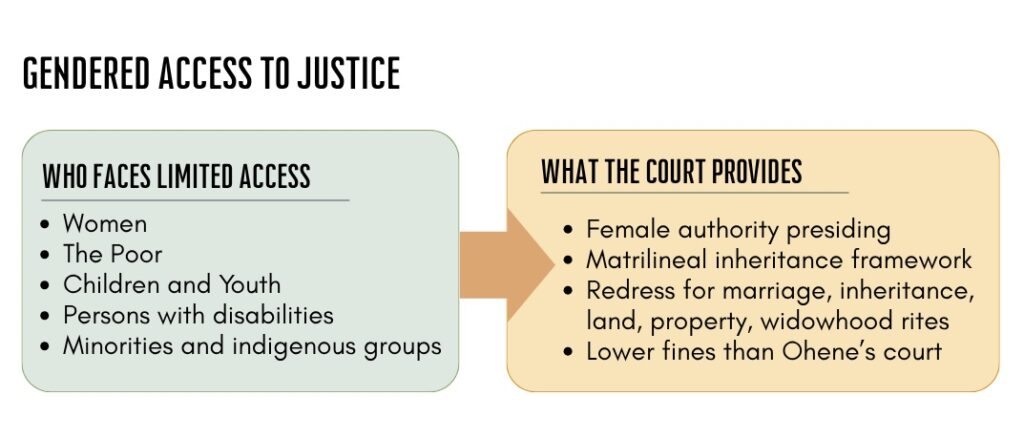
Within this context, the Asantehemaa’s court provides an important forum through which women can seek redress and exercise their rights. The court addresses matters such as marriage, inheritance, land and property access, and cultural practices, including widowhood rites that may conflict with women’s human rights. By offering a recognized customary space for dispute resolution, the court enhances women’s ability to pursue justice in issues that directly affect their social and economic security. At the same time, because the court operates within a matrilineal inheritance system and is led by a female authority, it may appear that women benefit from greater protection or recognition there than men.
CASES THE COURT TAKES ON
The Asantehemaa’s court primarily handles efisem, referring to interpersonal disputes and matters of social justice under Asante customary law. In contrast, the Asantehene’s court focuses on amansem, which addresses broader matters of state. Within this framework, the Asantehemaa’s court functions as an accessible venue for resolving everyday conflicts that affect families, communities, and local governance.
The cases brought before the court generally fall into four main areas. First are succession-related matters, including chieftaincy disputes, destoolment charges, customary succession processes, the allocation of stool property such as land, and power struggles involving chiefs, queenmothers, and other office holders. Second are interpersonal and domestic disputes, such as conflicts among family members, marriage-related issues including spousal neglect or abuse, child neglect, divorce settlements, as well as cases involving cheating (kwasiabuo) and insults (atenndie).
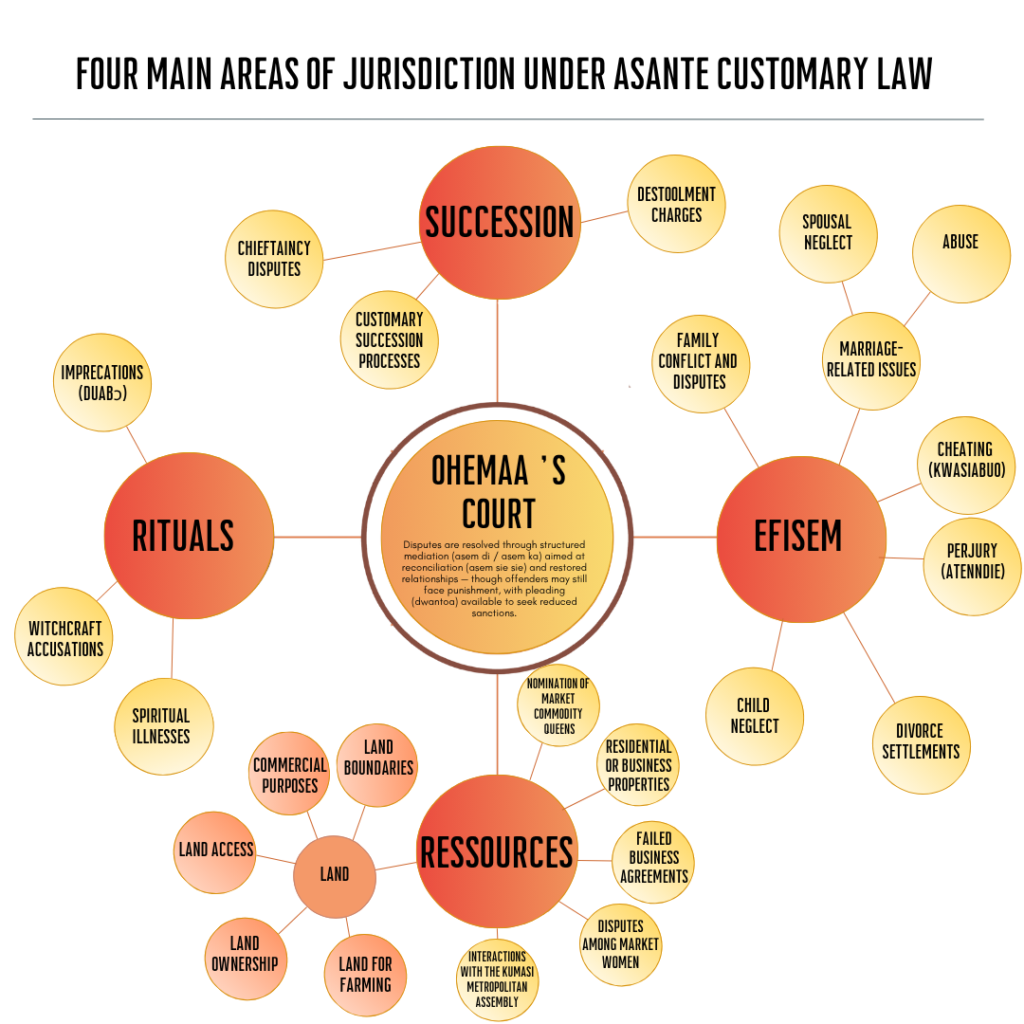
A third group concerns resource-related disputes. These include questions of land access, ownership, boundaries, and use for farming or commercial purposes; conflicts over residential or business property; failed business agreements; and market-related matters such as store allocation, disputes among market women, interactions with the Kumasi Metropolitan Assembly, and the nomination of market or commodity queens. Finally, the court also addresses ritual matters, including imprecations (duabↄ), witchcraft accusations, spiritual illnesses, and issues involving indigenous priests.
The Ohemaa’s court hears marital and child-related disputes, family (abusua) matters, market conflicts, imprecations (duabɔ), witchcraft accusations, and some resource-related cases. She also has jurisdiction over certain disputes involving men, including succession, inheritance, and marriage, and may act as a “pleading queen” to represent them before the Ohene’s court. Cases may be transferred to her court under Asante customary law, where fines are generally lower.
HOW INDIGENOUS CONFLICT RESOLUTION FUNCTIONS AMONG THE ASANTE
Among the Asante, conflict (asem) is recognized as a normal part of social life and may arise from direct or indirect offences. Disputes are addressed through mediation processes known as asem di or asem ka, which involve structured deliberation and dialogue between parties. The aim is reconciliation (asem sie sie), seeking to repair relationships and restore social harmony rather than escalate tensions. Although the process emphasizes settlement and restored relations, the offending party may still face punishment, with the possibility of pleading (dwantoa) for reduced sanctions as a means of making amends.
Asante dispute resolution emphasizes compromise, forgiveness, and reconciliation. The process relies on deliberation, dialogue, cross-examination, apology, compromise, ritual fact-finding, and dwanetoa, often aiming to restore social harmony even when root causes are not fully addressed. In the Asantehemaa’s court, mediation (‘ye ka asem’) places the chief or queenmother between the parties, actively guiding discussions rather than leaving them to negotiate alone. The mediator facilitates dialogue, identifies fault, and encourages acceptance of responsibility and forgiveness.
Since conflict is understood as both social and spiritual, resolution may also involve ritual practices such as oath-swearing (kokoniwa), animal sacrifice, fines, and formal pleas for forgiveness. These rituals, witnessed symbolically by the ancestors, affirm that the dispute has been settled and may serve to pacify or cleanse the offended party.
POWER DYNAMICS AND DECISIONS OF THE COURT
Although the Asantehemaa’s court is female-led, it includes both male and female panelists who serve as co-judges in customary arbitration. These judicial duties are regarded as a form of service (esom) to the Asantehemaa, Asanteman, and the sika dwa. Decision-making is collective, and while women participate fully, custom encourages their authority to remain discreet, often resulting in male chiefs speaking on behalf of female counterparts during deliberations.
Institutionally, the Asantehemaa’s office is independent from that of the Asantehene, though both are expected to consult and complement each other. She has access to his court and may veto its decisions, whereas he does not have equivalent authority over hers. Despite broader norms of masculine dominance in chieftaincy, the Asantehemaa’s court retains significant autonomy and has demonstrated effectiveness in conflict resolution, dispute management, and the maintenance of communal harmony and ritual obligations.
CONTRIBUTION TO COMMUNITY PEACE
Akan Queenmothers play an active role in grassroots governance, resolving disputes within families and lineages and serving as community gatekeepers. Outcomes at their courts typically result from a combination of individual agreements, third-party mediation, and background negotiations led by the queenmother and her elders. These processes may involve private or joint meetings, pleas, ritual actions, oaths, and compromise prior to before formal hearings.
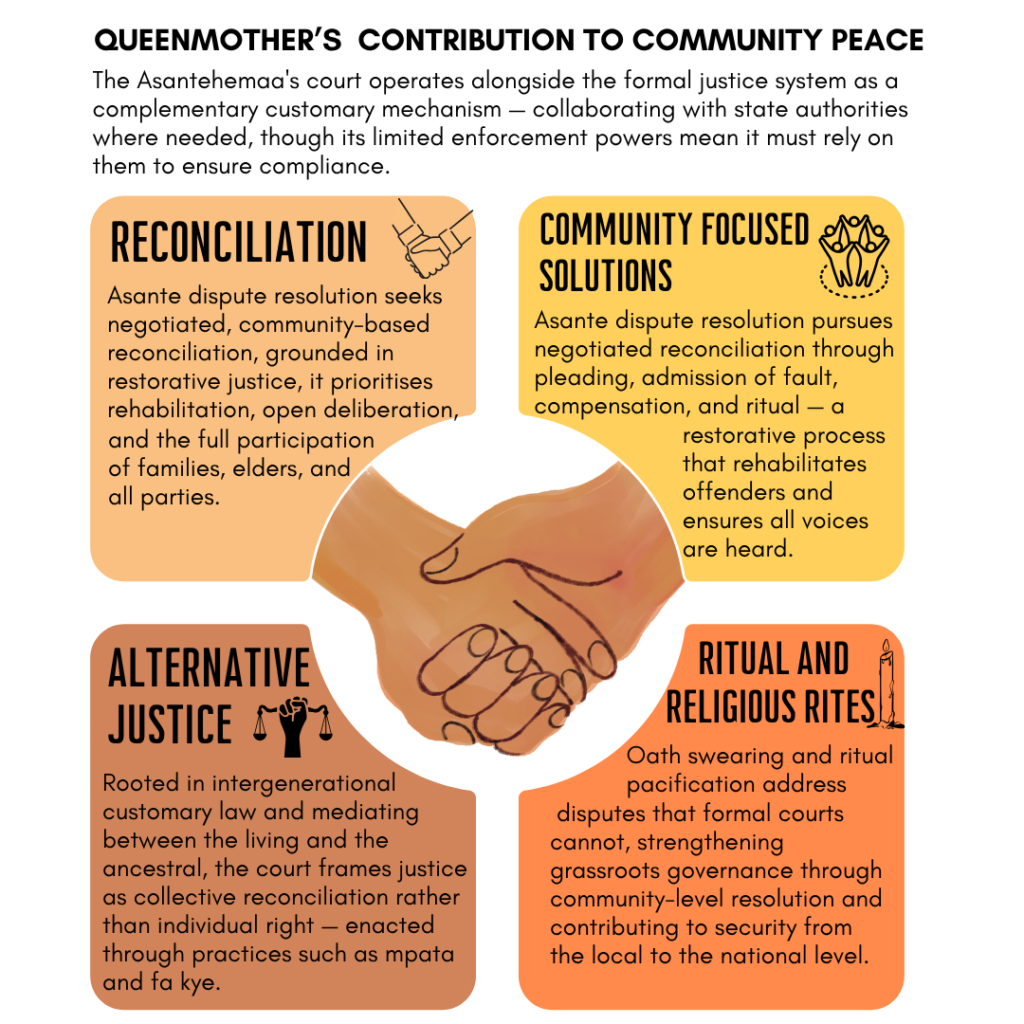
Reconciliation
Asante customary arbitration is grounded in restorative justice, prioritizing reconciliation over punishment. The Asantehemaa’s court presents itself as providing culturally rooted, alternative justice based on customary laws passed down through generations, while also acting as an intermediary between the ancestors and the living. Through mechanisms such as mpata, fa kye, and related practices, justice is framed as reconciliation and community harmony, understood as a collective good rather than an individual right.
Community focused
Asante dispute resolution does not follow a winner–loser logic but seeks negotiated, community-based solutions aimed at reconciliation. The process involves negotiation, pleading (dwanetoa), admission of fault (di fↄ), compensation (mpata), rituals, and the participation of families and elders, reducing tension and avoiding the adversarial nature of formal courts. Grounded in restorative justice, it emphasizes rehabilitation, reintegration of offenders, and open deliberation, allowing grievances, litigants, and witnesses to be fully heard.
Application of ritual and religious rites
The use of oath swearing and ritual pacification reflects the customary character of the court, particularly for disputes such as imprecations that cannot be addressed in formal legal systems. This form of customary arbitration strengthens grassroots governance by enabling community-level resolution of conflicts, thereby contributing to local peace and broader district, regional, and national security.
Significance of customary courts in Ghana’s Hybrid system
The Asantehemaa’s court is an example of an indigenous dispute resolution mechanism within Ghana’s African Dispute Resolution system, functioning alongside and complementing the formal justice system, which cannot always ensure access for all. While it serves both men and women, it provides particularly important, gendered access to justice for women, especially in matters such as marriage, inheritance, land rights, widowhood practices, and culturally grounded disputes, including ritual or witchcraft-related cases that formal courts are less equipped to address.
The court sometimes collaborates with state authorities, including the police, particularly in cases involving threats or physical harm, illustrating the complementary relationship between customary and formal systems. However, because customary courts lack full enforcement powers, they may rely on state institutions to ensure compliance. Although the court emphasizes oath-swearing and restorative justice as mechanisms encouraging adherence to rulings, from a legal perspective stronger constitutional recognition would be needed to formally empower enforcement of its decisions.
Traditional and Religious Leaders in conflict resolution
Traditional and religious leaders play an important role in peacebuilding, conflict resolution, and social cohesion across Ghana. They actively address local tensions and disputes, promote interfaith and interethnic tolerance, and contribute to preventing the conditions that can enable violent extremism.
Christian and Muslim leaders regularly engage in dialogue to strengthen religious tolerance, peace, and stability, and to deepen relationships between faith communities. Religious institutions such as the Christian Council of Ghana, the Catholic Church, the Assemblies of God Ghana, and the Ahmadiyya Muslim Mission Ghana actively mediate conflicts and promote peace through education, dialogue, and capacity building. Notably, Sheikh Osmanu Sharubutu, the National Chief Imam, has consistently used diplomacy, religious authority, and social capital to encourage interfaith dialogue and prevent tensions, including intra-Muslim conflicts. In July 2022, he partnered with the Ghana Catholic Bishops’ Conference to host a Muslim–Christian dialogue aimed at fostering peace and religious tolerance.
Faith-based organisations have also contributed to institutionalised peace infrastructures. The Catholic Church played a leading role in the establishment of the National Peace Council (NPC), which serves as a national mechanism for mediation and conflict prevention. Religious leaders continue to serve within NPC structures, leading mediation, dialogue, conflict resolution, and peace education initiatives that are directly relevant to preventing and countering violent extremism (P/CVE). Through the NPC, Christian and Muslim leaders work jointly to promote tolerance, peaceful coexistence, and non-violent engagement.
The Ghana Catholic Bishops’ Conference is also implementing the Sahel Peace Initiative, which focuses on preventing violent extremism in Ghana and the wider Sahel through interreligious dialogue, strengthened social cohesion, and socioeconomic and environmental resilience.
At the local level, religious leaders conduct peace education, awareness campaigns, and community sensitisation on the risks of violent extremism, the importance of vigilance, and the need to report suspicious activities to security authorities. In northern border areas, sermons and teachings are used to discourage extremist ideologies and reinforce tolerance. Religious leaders often collaborate with traditional authorities to mobilise local resources and strengthen community resilience, and they frequently act as intermediaries by relaying early warning information from communities to security agencies.
Traditional authorities also play a key preventive role by mediating land, chieftaincy, and interethnic disputes, which can otherwise create openings for extremist exploitation. Leaders such as the Asantehene, the Nayiri, and the Yagbonwurawere instrumental in resolving the Dagbon chieftaincy conflict through sustained dialogue, reconciliation, and negotiated settlement. The Asantehene has also led mediation efforts in the Bawku conflict between the Kusasi and Mamprusi communities, submitting a report to the President, John Dramani Mahama, on 16 December 2025. Given Bawku’s proximity to border areas of Burkina Faso and Togo that have experienced violent extremist attacks, achieving a peaceful resolution remains critical for preventing violent extremism and terrorism. It is also notable that in certain respects the Asantehene may have inadvertently intensified the conflict given that one faction perceived his role as partial.