

Hybrid Security Governance in the Ghana Armed Forces
The workings of the hierarchical logic of the Ghanaian military operate through both formal and informal mechanisms. While the military operates as a hierarchical and supposedly professional institution governed by codes of conduct, regulations, and chains of command, its everyday functioning is equally shaped by informal norms, cultural practices, and social dynamics that interact with — and at times cut across — official rules. This hybrid character manifests across several dimensions of military life, notably through the way seniority orders relationships both officially and socially; the cultural practice of djuan toa (plead for clemency) through which soldiers seek to avoid formal sanctions; the generational tensions between the ‘Old Soldier,’ the Computer/Internet Soldier, and the Telephone Soldier; the particular position of Barracks Boys within the institution; and the patronage exchanges that shape relations between the military and the political class.
Together, these dynamics illustrate how command, discipline, and loyalty in the Ghana Armed Forces are negotiated as much through informal norms as through official regulations.
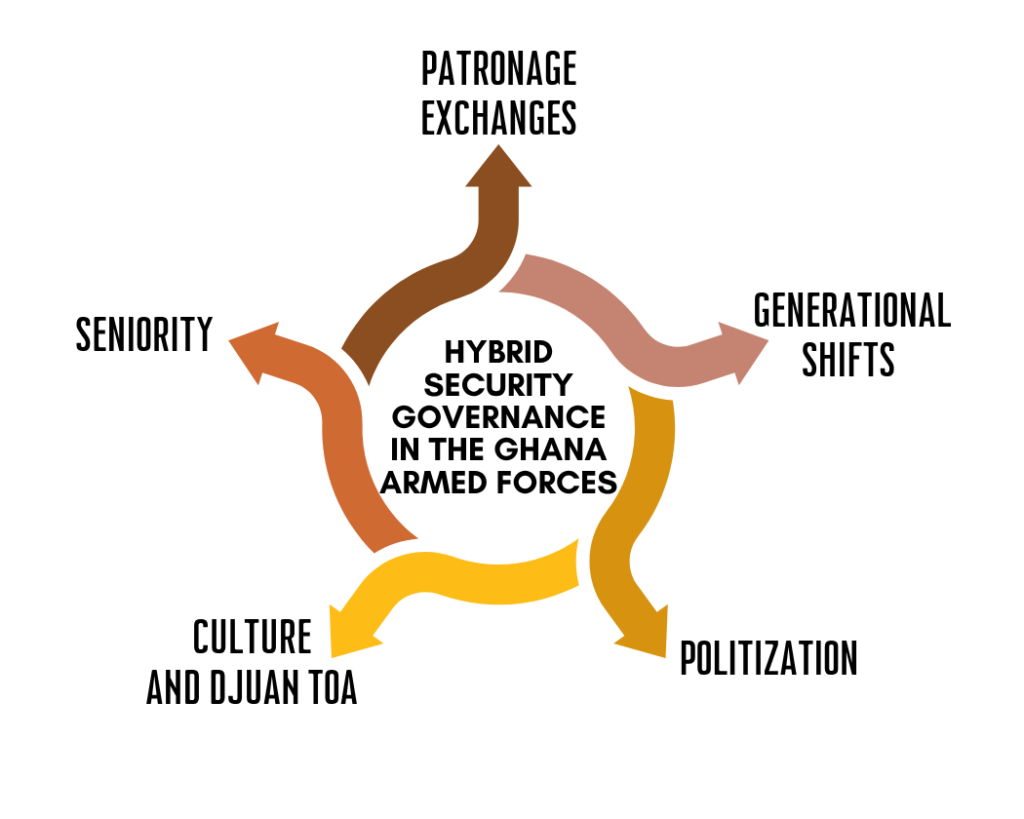
As a professional body, the Ghana Armed Forces are governed by a wide range of formal instruments, including the Armed Forces Regulations Volume Two, which specifically addresses discipline. Armed Forces Regulations Volumes 1, 3, and 4 cover administration, finance, and civilian employees, respectively. Other governance instruments include the Part I Orders, the Command and Staff Instructions and Procedures (CSIPs, Volumes 1–6), and the Ministry of Defence Instructions (MDIs). These represent formal modes of security governance, or what Jaffe terms “playing by the book” (Jaffe 1984). However, the hybrid security governance structure is most visible in everyday practices at the battalion or unit level, where commanders combine formal instruments with informal socio-cultural norms to manage the military institution. At this level, formal rules and informal practices coexist and jointly shape the hybrid system of governance.
SENIORITY
An important element of the hierarchical organisation of the Ghana Armed Forces is seniority. Date of enlistment, promotions, office (for example, commanding officer (CO) or regimental sergeant major (RSM)), and rank are intertwined and converge to produce hierarchy within the barracks. Seniority functions as a social mechanism that regulates relationships based on an individual’s affiliation with the military. In the Ghanaian barracks, seniority is associated with authority, privileges, prestige, and responsibilities, and is closely linked to hierarchy.
At the same time, both seniority and hierarchy operate through formal and informal practices, making them central to the hybrid security governance structure. For example, when opportunities for travel abroad arise, typically prestigious and limited, senior officers are considered first. Seniority therefore orders and arranges soldiers within the institution and determines responsibility. Furthermore, given the relatively small size of the Ghana Armed Forces (between 15,000 and 23,000 operatives), soldiers generally know their superiors and subordinates based on regimental numbers, and the same awareness applies in reverse.
Ranking and appointments are formal determinants of a soldier’s seniority, but they can also disrupt established seniority arrangements within a unit, particularly among non- commissioned officers (NCOs). For instance, when several warrant officers from the same cohort compete for the position of regimental sergeant major (RSM), only one can be selected following a competitive process. In some cases, the officer who was previously the most junior in the group may be appointed to the role.
Through this appointment, that individual becomes the most senior within the unit and gains authority over former peers, who are then required to take orders from him due to his promotion to the higher rank of senior warrant officer. This dynamic illustrates how formal structures such as rank and appointment interact with informal perceptions of seniority, jointly shaping the hierarchical logic of the Ghana Armed Forces.
CULTURE
Cultural elements that enter the Ghanaian military barracks primarily shape informal norms and, over time, influence how formalized rules and instruments are applied. In this way, they directly affect the hybrid security governance structure. Formalized sanctions carry significant social and professional consequences, leading soldiers to make considerable efforts to avoid disciplinary action.
All formal infringements and sanctions are recorded in a soldier’s professional file as part of the formal governance system. These records have long-term implications, as a poor disciplinary history can negatively affect career progression and professional development within the Ghana Armed Forces.
Colleagues also tend to avoid soldiers with reputations for indiscipline, as association with such individuals may raise concerns about their own judgement. For this reason, formalized sanctions are widely viewed as undesirable—particularly among junior officers and other ranks—and are often perceived as “wicked, rigid and old” within the Ghanaian military. By contrast, informal punishments are considered more “humane” because they do not carry consequences beyond the unit. Offending soldiers therefore seek to avoid formal sanctions due to their lasting professional implications.
DJUAN TOA : PLEADING FOR CLEMENCY
Within this context, djuan toa has emerged as a cultural mechanism that functions as an informal form of governance. Rather than attempting to avoid punishment altogether, an offending soldier may organize djuan toa to plead with a superior for an informalized sanction. This practice of pleading through intermediaries has gained traction in the barracks because it reduces the professional and administrative consequences associated with formal discipline. Soldiers typically assemble respected figures, such as a superior’s course mates, hometown or village chiefs, or family heads, to strengthen their appeal, as “you want your superior to listen to your plea.”
However, this practice can undermine formal disciplinary standards, as superiors may feel compelled to apply informal sanctions or set aside established professional norms.
The socio-cultural practice of pleading for clemency, and the broader cultural value placed on leaders’ capacity for mercy and forgiveness, creates challenges for military commanders, who are not always able to uphold strict professional norms and disciplinary standards. This expectation can pressure leaders to be lenient, thereby undermining formal rules, established procedures, and professional standards, and encouraging reliance on informal sanctioning practices instead.
GENERATIONAL SHIFT IN THE GHANA ARMED FORCES (GAF)
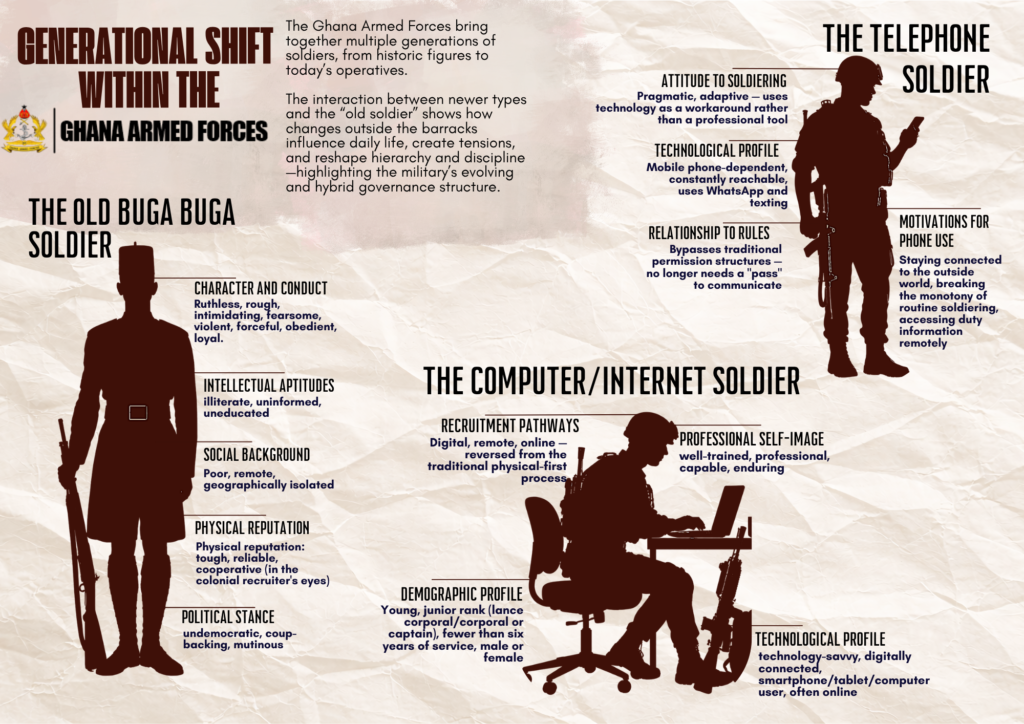
The Ghana Armed Forces bring together different generations and types of soldiers, from historic figures to current serving operatives. The interplay between newer categories of soldiers and the ideal-typical “old soldier” illustrates how developments outside the barracks shape everyday interactions, generate tensions between established and emerging actors, and affect hierarchy and discipline in unintended ways. These dynamics reflect the evolving and hybrid nature of the military’s governance structure.
Buga-Buga Nostalgia
The Old Soldier is a construct or an assemblage of different older generation of soldiers in the Ghana Armed Forces. The Old Soldier’s nostalgia represents a legacy of a past military order shaped by the historic soldier subject of the Buga-Buga soldier, who is widely recognized across generations of soldiers in the Ghanaian barracks. ‘Buga-Buga’ comes from the Hausa word ‘bugashi’ meaning “to apply force”.
The Buga-Buga soldier refers to a pre- and post-colonial type of soldier, known for rough conduct and generally limited literacy. British commanders promoted the idea that the ideal soldier should be illiterate and drawn from remote areas and were therefore “in no great hurry” to disrupt what they considered military values and simple loyalty through formal education. As a result, colonial administrators deliberately avoided educating colonial soldiers, keeping them uninformed in order to extract strict obedience and loyalty.
The Buga-Buga soldier was typically recruited from the northern parts of Ghana, as British colonial authorities preferred these areas, viewing northerners as belonging to a so-called “martial race”.
Prior to independence, tribes from the so-called “Northern Territories” were described as being in a near-constant state of conflict with one another. This made men from these areas particularly appealing for recruitment into the colonial armies, as it aligned with colonial stereotypes of the warrior figure sought by recruiters, men considered tough, reliable, and cooperative. British authorities also viewed these recruits as less likely to participate in nationalist demonstrations, labour disputes, or other forms of internal unrest, partly because of their geographical distance from political and administrative centres in the south.
The Buga-Buga soldier typically joined the military because he came from poverty-stricken areas where opportunities for education were limited. Military employment was therefore extremely important, as it provided income, status, and prestige within his hometown. Between 1901 and 1939, most men in the colonial military of the Gold Coast, estimated at between eighty and ninety per cent, were recruited from the north.
The Old Soldier recalls that due to the low literacy level of the Buga-Buga troops, whenever the Part I Orders (which spells out the tasks and duties of soldiers for the week) were published, a Muster Parade had to be organized for the orders to be read out loud and, where necessary, explained to the soldiers. The Buga-Buga soldier was ruthless, thus making civilians shiver at his sight. as the Buga-Buga soldier was known to execute his tasks with whatever means possible, including the use of (excessive) violence or force the Buga- Buga soldier reigned the barracks with fear and intimidation, which regularly resulted in beatings of his subordinates or severe punishments, such as running rounds in full battle gear in the scorching Ghanaian heat; in some cases until the subordinates passed out from exhaustion.
At independence, the Ghana Armed Forces inherited apart from the British command structure, also, among others, the dress codes, drills, military greetings and parade inspections which persist until today. The Ghanaian military can be considered a collection of bodies with historic memory in which knowledge is transmitted to next generations through training regimes. Similarly, the Old Soldier’s body contains remnants of the military’s (colonial) history, including the ways of the colonial Buga-Buga soldier, but also British drills, greetings, parades and dressing.
The Buga-Buga soldier is associated with the coups of the past, mutinies, his backing of undemocratic military regimes. The Buga-Buga soldiers were used by coup-makers (for example, flight lieutenant Jerry John Rawlings’ coups in 1979 and 1981 for their illegal activities. Although the Old Soldier has distanced himself from the Buga-Buga soldier, certain elements of this earlier military tradition remain present. Some practices and methods associated with the Buga-Buga soldier continue to form part of the repertoire and institutional culture of the Ghana Armed Forces.
The Computer/Internet Soldier
Changes in the Ghana Armed Forces have evolved alongside broader societal developments globally, resulting in the emergence of a new type of soldier who is highly technology-savvy. Contrary to the Old Soldier, the Computer/Internet Soldier is of the rank of lance corporal/corporal in the other ranks (OR) corps, or a captain in the officer corps. The Computer/Internet soldier considers himself a well-trained military professional, who is just as good a soldier as the Old Soldier. The Computer/Internet Soldier’s conviction is further based on his endurance of the pain associated with military service.
This new type of soldier no longer requires a “pass” or written permission to remain in contact with peers and friends both within and outside the barracks. As a result, the military environment has gradually become more open to the outside world, and vice versa. Younger soldiers (in particular) often own and make intensive private use of smartphones, tablets, and computers.
By contrast, the Old Soldier typically shows little or no interest in technological devices, often citing only an older mobile phone as the sole modern tool in use. This generational gap within the rank-and-file of the Ghana Armed Forces has contributed to a degree of suspicion toward younger soldiers among the Old Soldier cohort.
The Old Soldier often argues that discipline has declined with the arrival of technology-savvy recruits. For this reason, younger personnel are sometimes labelled the “Computer/Internet Soldier,” a term that also reflects their different recruitment pathway. The Computer/Internet Soldier typically refers to younger men and women who have served for no more than six years and who entered the service through digital recruitment processes. This contrasts with the traditional pathway followed by the Old Soldier.
Previously, recruitment was conducted physically across the regions of Ghana. According to a recruitment officer, the process began with height measurements, followed by competitive physical trials on the racetrack, where only top performers advanced. Candidates then completed written examinations and medical assessments, after which the military selected those deemed qualified.
Today, the process is largely reversed. Applicants first apply online through what the military describes as a “remote selection” system, using an e-recruitment card to access the recruitment portal. Once their applications meet the required criteria, candidates are invited for physical screening and medical examinations, followed by written tests. Those who pass are then selected for military training within the Ghana Armed Forces.
The Telephone Soldier
Another emerging type of soldier in the barracks is the so-called Telephone Soldier, a label derived from the frequent use of mobile phones, not only to stay connected with the outside world but, in some cases, to break the monotony of everyday soldiering routines. Similar to the Computer/Internet Soldier—and sometimes the same individual—this soldier also relies on technology, though often for different purposes.
Both the Telephone Soldier and the Computer/Internet Soldier reflect an ongoing transformation within the barracks, and their presence does not unsettle one another. With the widespread use of mobile phones, seeking permission to remain in contact is no longer always necessary, as soldiers can be reached anywhere and at any time. For example, a colleague outside the barracks can be called, texted, or contacted via WhatsApp to receive information about duties as published in the Part I Orders. These practices can be considered new approaches to soldiering within the Ghana Armed Forces.
THE BARRACKS BOYS
The “Barracks Boys” have long been part of the Ghana Armed Forces. The first group, recruited in 1953 into the Junior Leaders’ Company (Boys’ Company), consisted largely of the children of colonial servicemen. In earlier periods, most barracks boys entered the other ranks corps, although some later advanced into the officer corps.
In contrast, most of the current generation serve directly within the officer corps, and the group now increasingly includes women, often referred to as Barracks Girls. Those in the officer corps up to the rank of captain are, by definition, Computer/Internet Soldiers, having enlisted through the Armed Forces’ e-recruitment system. These soldiers are not considered Telephone Soldiers, as they are not characterised by political affiliation.
Barracks Boys are young soldiers and officers whose parents have served, or continue to serve, in the Ghana Armed Forces. Many were born and raised within the military barracks. This reflects a pattern often described as “endo-recruitment,” the practice of recruiting new soldiers and officers from families where a parent or relative is already a military operative. The underlying assumption is that children of military personnel develop an appreciation for military service through ties of emotion, kinship, and shared memory. In this context, the Ghanaian military’s hybrid security governance structure provides an example of how different generations of soldiers can be accommodated while managing their distinct characteristics and experiences.
PATRONAGE EXCHANGES
Due to the prominence of the Ghana Armed Forces in both societal and political life, successive civilian governments have sought either to establish influence within the barracks or to reduce the military’s role in the political arena, often with limited success. These political interventions are shaped by patterns of patronage and exchange between the military establishment and the country’s political elite, which in turn influence and reinforce the hybrid security governance structure.
In this context, patronage exchanges refer to give-and-take or two-way negotiations between politicians and the Ghana Armed Forces. These interactions operate both at the individual level for soldiers and at the broader institutional level within the military establishment.
In practice, interactions between the political class and the Ghana Armed Forces often take the form of patronage exchanges, which function as reciprocal relationships through which cooperation and support may be fostered. For some soldiers, these exchanges can create pathways to appointments, promotions, or professional prestige.
In this context, patronage involves mutual benefit rather than one-sided dependence. Some military operatives actively engage in such relationships in pursuit of career opportunities or positions of responsibility, while political actors may seek cooperation or loyalty through similar channels. These dynamics illustrate how exchanges operate as negotiated and reciprocal arrangements between both parties.
Politicization by Political Actors
In Ghana’s political system, the president and the 275-member parliament are elected every four years. The Constitution grants the president the authority to appoint the Chief of Defence Staff (CDS) as well as the commanders of the army, air force, and navy, which gives these positions a political dimension. As a result, senior appointments and promotions can become part of broader negotiations and relationships between political authorities and top military leadership.
Such appointments may place trusted individuals in key offices and, in some cases, be accompanied by post-retirement roles. In recent years, it has become relatively common for some senior commanders to receive appointments as Ghana’s ambassadors after retirement. Within the barracks, these appointments are often perceived as recognition or rewards for past service and cooperation with political authorities. Soldiers of lower rank or non-commissioned officers who have connections to influential political figures may use these relationships to gain access to decision-making circles. For example, some may seek deployment to guard duties at Jubilee House, Ghana’s presidential residence.
Although former military commanders engaging in politics is not a new phenomenon in Ghana, such activities are still frowned upon as the Ghana Armed Forces’ code of conduct explicitly forbids military operatives from openly and actively engaging in any form of partisan politics.
Previous efforts by civilian governments to politicize the Ghana Armed Forces often coincided with periods of instability, including coups. However, former junta leader Jerry John Rawlings was able to consolidate control and secure loyalty within the military. Subsequent governments developed alternative approaches to engaging the armed forces without provoking similar disruptions, drawing on elements of Rawlings’ strategy while introducing new measures. These approaches sought to engage both individual soldiers and the institution through initiatives and projects intended to benefit the entire armed forces.
In 2000, following Rawlings’ presidency, Ghana’s security sector, including the Ghana Armed Forces, faced significant challenges. The new administration led by John Agyekum Kufuor of the New Patriotic Party undertook reforms and measures aimed at strengthening relations with the security sector and rebuilding support.
Despite their influence in Ghana’s political history and society, the Ghana Armed Forces make sustained efforts to present themselves as a politically neutral institution. Political neutrality is treated as a core principle and is reinforced through regulations and codes of conduct that guide soldiers’ behaviour and activities, as well as through institutional measures aimed at preserving this stance, including public relations and civilian assistance programmes.
Since the early 1980s, the Ghanaian military has undergone a gradual transformation that has contributed to its recognition as one of the most trusted institutions in the country.