Sahelian Islamist armed groups have increasingly signalled their intention to extend their operations toward coastal West African states, and their areas of activity have progressively moved closer to Ghana. Groups such as Jama’at Nasr al-Islam wal Muslimin (JNIM) have expanded from rear bases in eastern Burkina Faso and southwestern Niger into Benin and Togo, while consolidating positions in northern Benin and the W-Arly-Pendjari Complex. JNIM affiliate Katiba Macina operates along the borders of Burkina Faso, Côte d’Ivoire, and Ghana, with additional elements linked to Ansarul Islam active in transborder zones approaching Ghanaian territory. Although these groups, alongside Islamic State in the Sahel (ISS), are not currently pursuing a direct offensive strategy against Ghana, they are establishing logistical bases and training hubs in coastal areas. As violence spreads southward from the Sahel and begins to merge with existing tensions along the coast, the regional threat environment is shifting — and Ghana’s exposure to violent extremism is growing as a result.
Field research by led by the organization Promediation indicates the possible emergence of jihadist cells in Ghana’s five northern regions, particularly Savannah and Upper East. Since 2019, Ghanaian authorities have reported repeated incursions by individuals and groups from Burkina Faso, Niger, Mali, and Nigeria. Ghana’s proximity to Burkina Faso’s Cascades region and northern Côte d’Ivoire increases its exposure, with militant activity in southern Burkina Faso posing direct risks to the northern border.
The growing presence of Katibas affiliated with Jama’at Nasr al-Islam wal Muslimin (JNIM) in the Cascades region and along cross-border zones has positioned northern Ghana as both a strategic fallback area and a corridor for mobility, logistics, and recruitment. Several katibas operate from forested rear bases in Burkina Faso near the Ghanaian frontier, with reported deployments and isolated security incidents affecting nearby border communities, while other groups remain active primarily on the Burkinabè and Ivorian sides.
Overall, Ghana currently appears to function mainly as a logistical corridor for JNIM, facilitating the movement of supplies, resources, and recruits. The absence of large-scale attacks on Ghanaian territory is therefore interpreted as a strategic choice aimed at preserving these networks and avoiding direct confrontation with Ghana’s security forces.
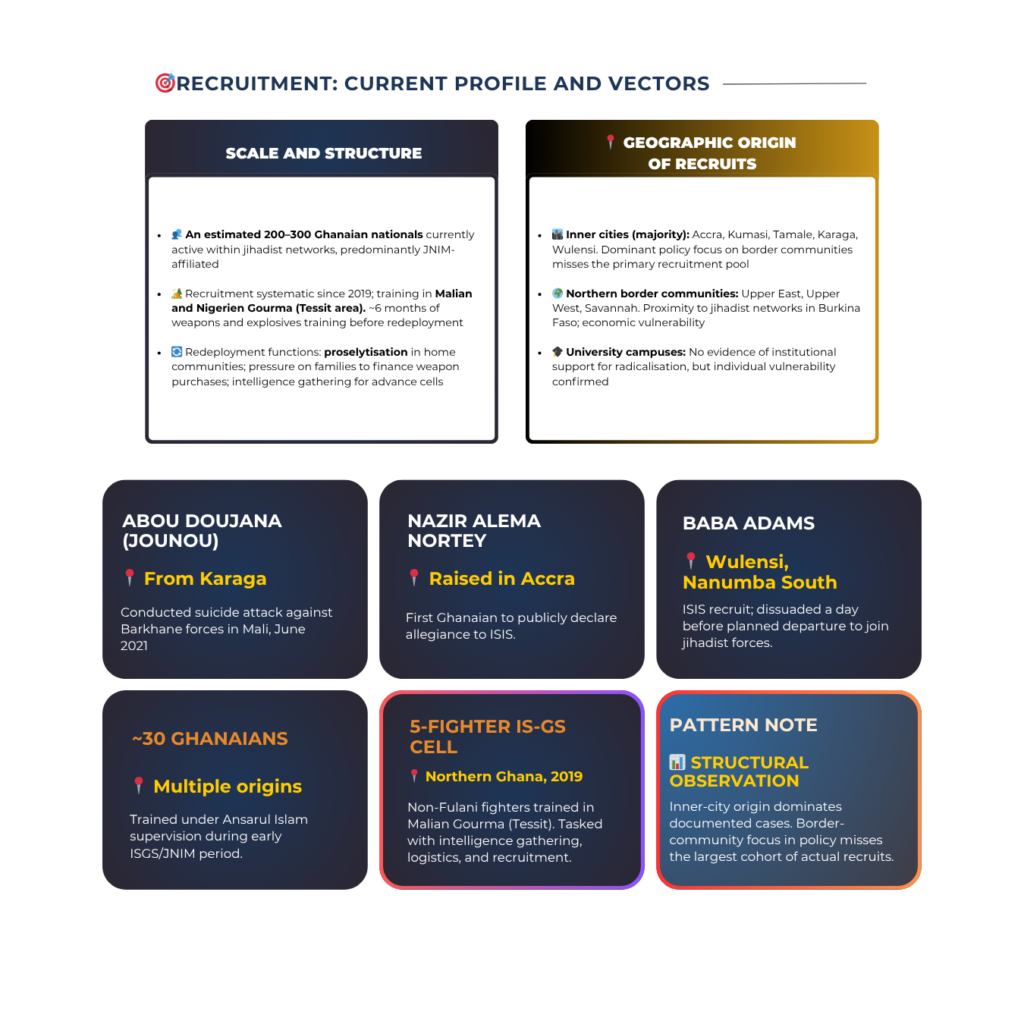
The stated ambitions of Sahelian jihadist groups to expand toward coastal states are reflected in the presence of fighters from countries such as Ghana in armed groups operating in the Sahel. Arrests and intelligence findings have pointed to cross-border networks linking Burkina Faso with Benin, Togo, Ghana, and Côte d’Ivoire, suggesting efforts to extend operations southward. Reports also indicate the presence of Ghanaian nationals in training camps in the Malian and Nigerien Gourma region, with the apparent objective of later redeploying them to their home areas.
Sustained recruitment and movement of returnees raise concerns about longer-term local entrenchment, particularly in peripheral and border regions of northern Ghana. Some recruits are described as returning to their communities after training to engage in proselytising and recruitment, including pressure for financial or logistical support. Documented travel flows involve the Upper East, Savannah, Eastern, and Northern regions, with small groups reportedly receiving training in weapons handling and explosives.
Elements currently present in Ghana are described as linked mainly to Jama’at Nasr al-Islam wal Muslimin (JNIM), with indications of evolving allegiances among networks formerly associated with Islamic State in the Greater Sahara (ISGS). The expansion of these groups toward Ghana’s borders, combined with reported links to artisanal gold-mining zones and supply chains, suggests the use of local economic and cross-border networks to sustain logistics, mobility, and influence.
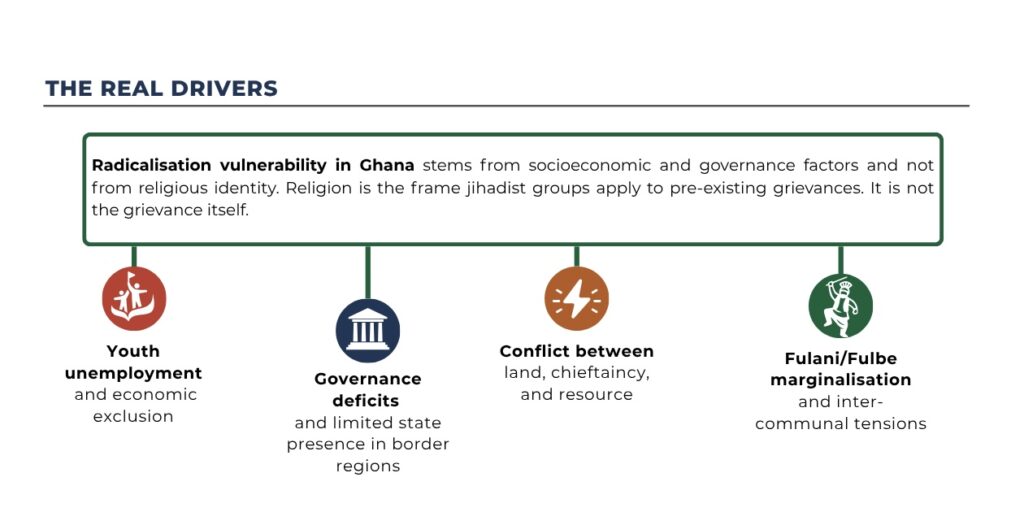
Involvement in parallel economic circuits and control over key nodes of illicit trafficking have facilitated the presence and gradual establishment of groups affiliated with JNIM in parts of northern Ghana. Areas such as Bawku in the northeast and clandestine gold-mining sites along the Côte d’Ivoire border function as hubs for trafficking, financing through taxation or zakat, preaching, and the recruitment of young people with limited prospects.
More broadly, control over grey-economy networks across the Sahel–Guinea corridor has supported this southward expansion, with rear bases embedded in illicit-trade centres such as Bawku, Cinkassé, and artisanal mining zones. In the Upper East, towns including Bawku, Garu, and Zebilla serve as transit points for arms and drug trafficking, with communal land conflicts contributing to widespread weapon circulation. In the Upper West, banditry, artisanal mining, and porous borders create conditions conducive to armed group activity, as mining sites operate both as trafficking nodes and recruitment spaces, despite occasional local resistance.
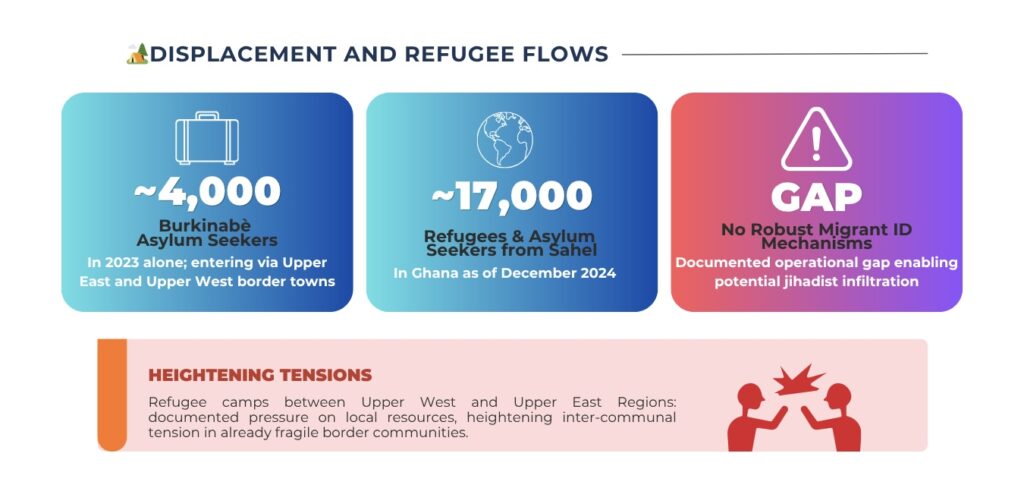
The management of population movements fleeing jihadist violence has become a growing concern for Ghanaian authorities. The security deterioration in the Sahel has given rise to destabilizing migration dynamics, notably through the intensification of violence in Burkina Faso, which has resulted in large-scale population displacement.
The establishment of refugee camps between the Upper West and Upper East Regions now represents both a humanitarian and a security challenge. The implementation of regulatory and identification measures for migrants and refugees is a critical issue in preventing the infiltration of jihadist elements among displaced populations.