Elections and Electoral Violence
Ghana returned to constitutional rule in 1992 after a long spell of military rule between 1966 and 1992, with the exceptions of two brief spells of civilian rule. The transition from military regime to liberal democracy invariably involved a shift from periods of political instability that had characterised most of the post-independence era until the 1980s.
A significant development shaping Ghana’s democratic trajectory has been the elections that ushered in the Fourth Republic, which has since produced five elected presidents and a stable parliament that plays an important oversight role over the country’s security forces.
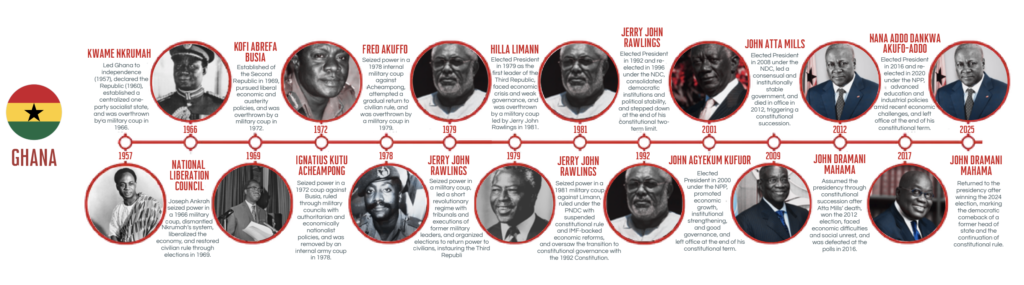
With a four-year electoral cycle, Ghana has held nine consecutive elections, marked by repeated peaceful transfers of political power between incumbent and opposition parties. Although the country operates as a multiparty democracy, political power has largely alternated between the National Democratic Congress (NDC) and the New Patriotic Party (NPP). Each party has served two four-year terms when in office, and both have overseen electoral processes in which security considerations have consistently featured prominently.
However, the security agencies, especially the police, are often accused of being biased and lacking the capacity to handle electoral offences and violence effectively. There is also the accusation that the security forces are often used by incumbent parties to intimidate political opponents.
ELECTORAL VIOLENCE
Incidents of violence have occurred at different stages of past elections. All nine general elections have recorded pre-election and post-election tensions, including the use of inflammatory language, vandalisation of political and electoral materials, gunshots, assaults, and, in some cases, human casualties. Violence has also been observed during several by-elections in constituencies such as Akwatia (August 2009), Chereponi (September 2009), Atiwa (August 2010), Talensi (July 2015), Ayawaso West Wuogon (2019), and Ablekuma North (2025).
In addition, violent incidents have been reported during and after party primaries, resulting in injuries and property damage, while voter registration exercises, both general and limited, have at times become flashpoints for political violence. Across these cases, questions have been raised about the role of the Ghana Police Service and its assurances of impartiality in maintaining public safety. This concern is partly linked to the visible involvement of political party security elements in major electoral activities, including general elections.
Over the years, a number of active vigilante groups have emerged. This trend runs counter to efforts aimed at democratic security sector reform and the professional management of election security, including the work of the National Elections Security Task Force, which is responsible for overseeing the security of elections across the country.
The National Elections Security Taskforce
The National Elections Security Task Force is responsible for safeguarding elections in Ghana. It brings together multiple state institutions, including the Ghana Police Service, the Ghana Armed Forces, the Ghana Immigration Service, the Ghana National Fire Service, the Ghana Revenue Authority through its Customs Division, and representatives from the Electoral Commission, the Research Department of the Ministry of Foreign Affairs and Regional Integration, and the Ministry of Local Government and Rural Development.
This structure is replicated at regional and district levels to ensure security coverage across all stages of the electoral process, including voting, counting, tallying, and the declaration of national ballots.
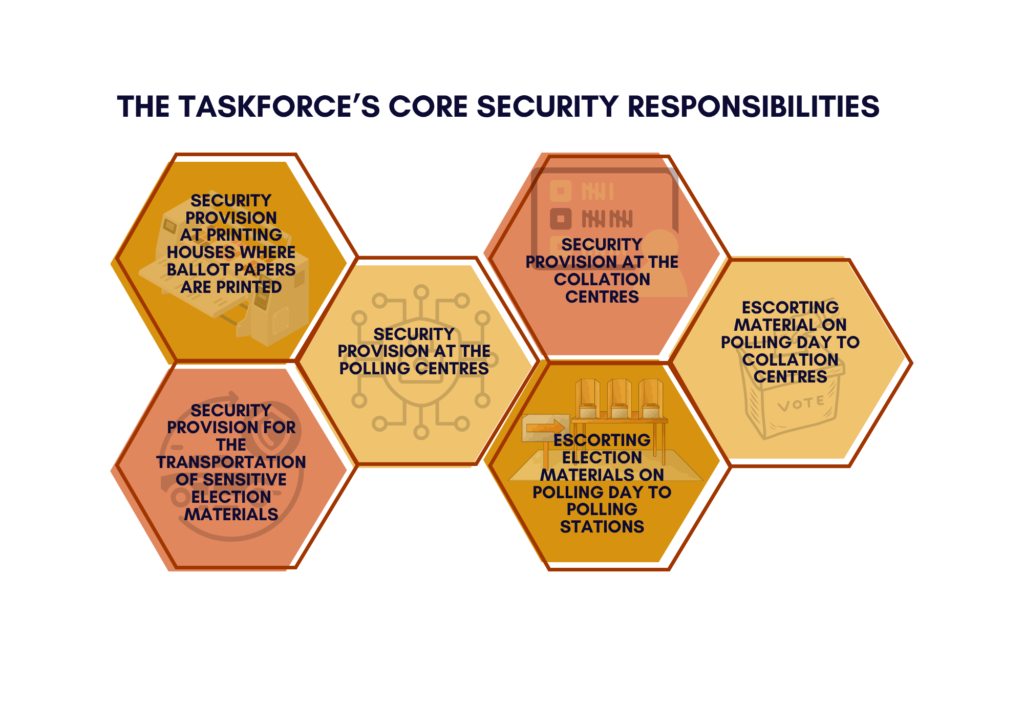
The Task Force’s core responsibilities comprise :
- Security provision at printing houses where ballot papers are printed;
- Security provision for the transportation of sensitive election materials;
- Security provision at the polling centres;
- Security provision at the collation centres;
- Escorting election materials on polling day to polling stations; and
- Escorting material on polling day to collation centres (Commonwealth Secretariat 2008).
To support these operations, the Task Force operates through specialised sub-committees covering legal and prosecution matters, intelligence and investigations, personnel mobilisation and deployment, ballot security, logistics and transport, as well as media and communication, finance and budget, and medical and welfare support.
In order to perform these duties adequately, the task force has sought to engage stakeholders such as political parties, the EC, the media, the National Commission for Civic Education, the National Peace Council, and religious leaders.
The National Elections Security Task Force and Political Party security
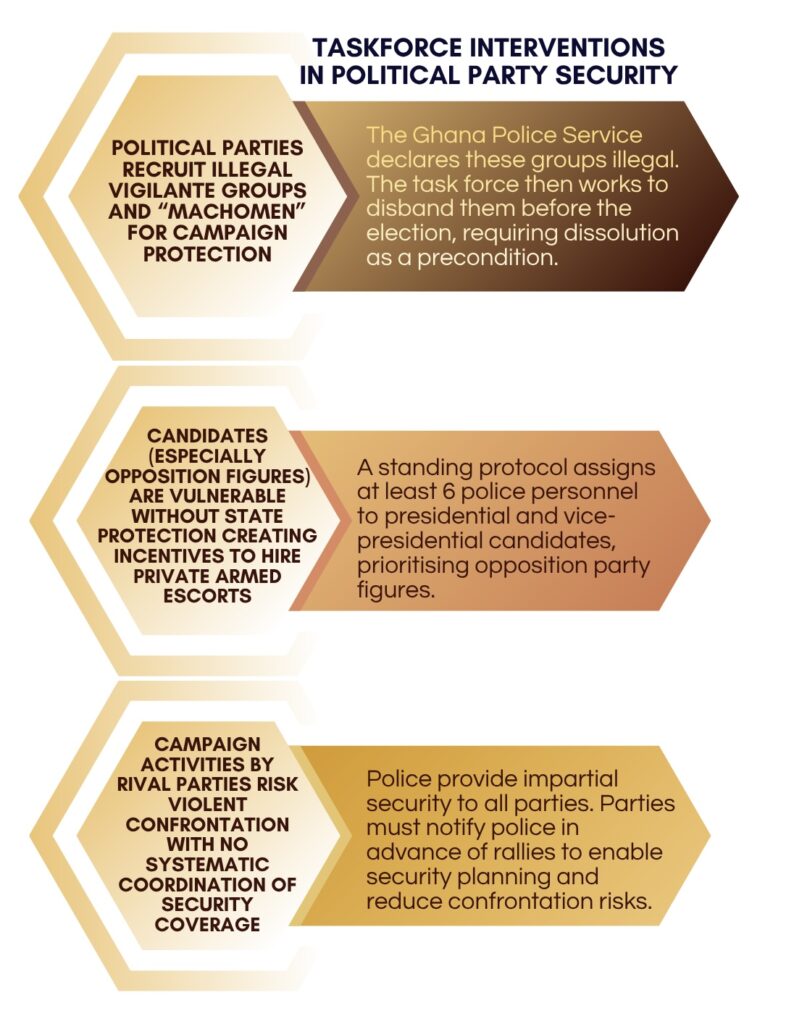
First, it has been focusing to disband party security and vigilante groups. The Ghana Police Service maintains that these groups are illegal and must be dissolved before elections.
Second, the police have introduced a standing protocol to assign security details to political actors. At least six security personnel are deployed to protect presidential and vice-presidential candidates, particularly those from opposition parties. This measure aims to discourage parties from recruiting “machomen” or other vigilante groups for campaign protection.
Third, the Task Force seeks to streamline political campaign activities to prevent clashes between rival parties. As the lead agency, the police are required to provide impartial security to all parties. In addition to protecting the Electoral Commission’s materials, the Task Force safeguards campaign events and requires parties to notify the police in advance of rallies and gatherings. This enables proper security planning and helps reduce the risk of confrontation during the campaign period.