

The provision of security, safety and justice services in South Sudan is complementary and reinforcing. The way these services are delivered is well provided in the Constitution and in various legislations.
Cumulative evidence suggests that non-state security actors are sometimes more effective than state security actors in the delivery of security, safety and justice, particularly in the countries that are fragile or emerging from conflict, as the presence of state security actors is weak, particularly in rural settings. In South Sudan, a majority of citizens rely on informal institutions for security, safety and justice.
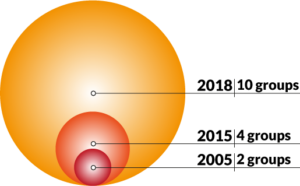 The phenomenon of the organised armed groups is new in South Sudan but it became prevalent during the counterinsurgency warfare in the Sudan’s second civil war (1983 – 2005). This phenomenon became even more rampant during the first (2013 – 2015) and the second (2016 – 2018) civil wars in South Sudan.
The proliferation of the organised armed groups increased considerably during the 2015 and 2018 Peace Agreements. This is attributed largely to the pattern of peace agreements that rewarded the armed groups in the power-sharing arrangements and created a gun-class that dominates the political marketplace in South Sudan.
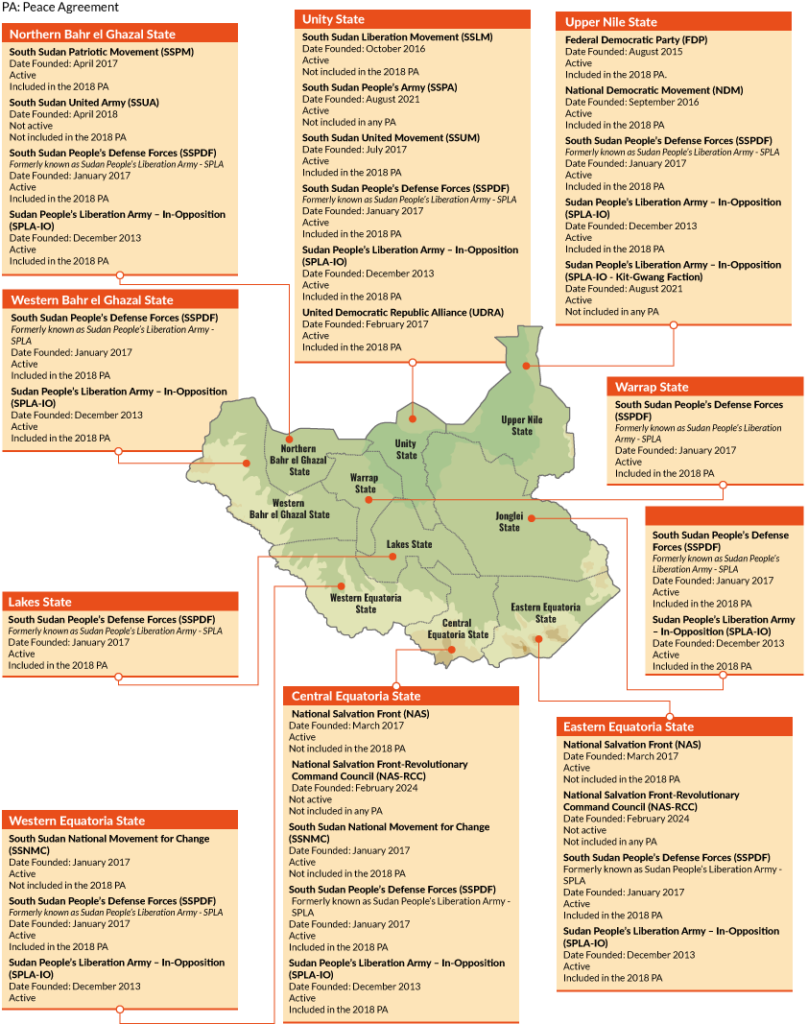
Sources: Luka Biong Deng Kuol, HSGO expert. David Deng, Compound fractures: political formations, armed groups and regional mediation in South Sudan.
Political Parties and Armed Groups Signatories to the 2018 Peace Agreement (R-ARCSS)
* The SSPDF is the national armed forces of the Republic of South Sudan. Although the SSPDF may not fit into the definition of organised armed groups, its history of formation provides some characteristics and traits of the organised armed group. It was formerly known as the Sudan People’s Liberation Army (SPLA), the military wing of the Sudan People’s Liberation Movement (SPLM) that fought more than 20 years (1983 – 2005) against the Sudanese Armed Forces. After the signing of the Sudan Comprehensive Peace Agreement in 2005, the SPLA was recognised as part of the national armed forces of Sudan. With the independence of South Sudan in 2011, the SPLA became the national armed forces of the new Republic of South Sudan. Following the eruption of the first civil war in 2013, the SPLA split into two factions along ethnic lines with one faction supporting Gen. Salva Kiir, the President of South Sudan, and the other faction supporting Dr. Riek Machar, the Vice President of South Sudan. Its name was later changed to the SSPDF.
**Led by Riek Machar, the SPLM/A has been the main armed opposition and emerged after the SPLA split in 2013.
Political Parties and Armed Groups Not-Signatories to the 2018 Peace Agreement (R-ARCSS)