The provision of security, safety and justice services in South Sudan is complementary and reinforcing. The way these services are delivered is well provided in the Constitution and in various legislations.
Cumulative evidence suggests that non-state security actors are sometimes more effective than state security actors in the delivery of security, safety and justice, particularly in the countries that are fragile or emerging from conflict, as the presence of state security actors is weak, particularly in rural settings. In South Sudan, a majority of citizens rely on informal institutions for security, safety and justice.
Legislation and non-state actors
There is often hybridity and pluralism in the provision of security, safety and justice with blurred or non-existent lines of jurisdiction between state and non-state, formal and informal, civilian and military, and traditional and modern, particularly in countries that are fragile and emerging from civil war such as South Sudan. Besides the recognition of the African Union of the role of the non-state actors in security sector governance, there is a legal framework in South Sudan within which the non-state actors could provide security, safety and justice services:
The Constitution
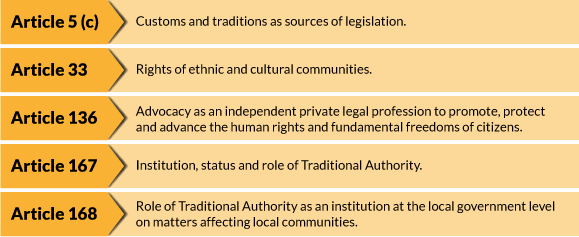
The 2011 Transitional Constitution of the Republic of South Sudan provides the following provision in recognition of non-state actors and informal institutions such as traditional authorities that are critical for the provision of conflict resolutions, peace, social order and justice:
The Local Government Act
The 2009 Local Government Act provides detailed provisions regarding the implementation of constitutional provisions. Traditional authority systems, customary law courts and their independence, status, and types of traditional authorities, composition, criteria for the establishment of decentralized chiefdoms, election or selection of chiefs and immunity of kings and chiefs are detailed in the following chapters:
South Sudan Police Service Act
The Police Act provides for the establishment of community policing “to help the Police Service in the performance of its functions and duties and to mobilize the people for the preservation of law and order”. Section 15 defines the following objectives of the Community Policing: