National Security Strategy (NSS)
Launched in 2021, Ghana’s National Security Strategy (NSS) is the first comprehensive strategy of its kind since independence. Recognised as one of the most peaceful and stable democracies in West Africa, reflected in its rankings on the Global Peace Index (GPI), Ghana developed the NSS to preserve this stability and strengthen its position as an anchor of peace and democracy within a volatile region.
The strategy was shaped by several key considerations. First, Ghana sought to shift the understanding of national security from a traditional, state-centred model toward a human security approach that places the individual citizen, rather than only territorial integrity and sovereignty, at the centre of security policy. Second, the previous model largely confined security management to state institutions. The NSS therefore promotes a whole-of-government and whole-of-society approach, encouraging closer collaboration between security actors and the public. Third, before the NSS, State Security and Intelligence Agencies operated under separate and fragmented policy frameworks, which often led to poor coordination and duplication of efforts. The NSS was introduced to consolidate these frameworks into a single blueprint, improving coherence, coordination, efficiency, and accountability across the security sector.
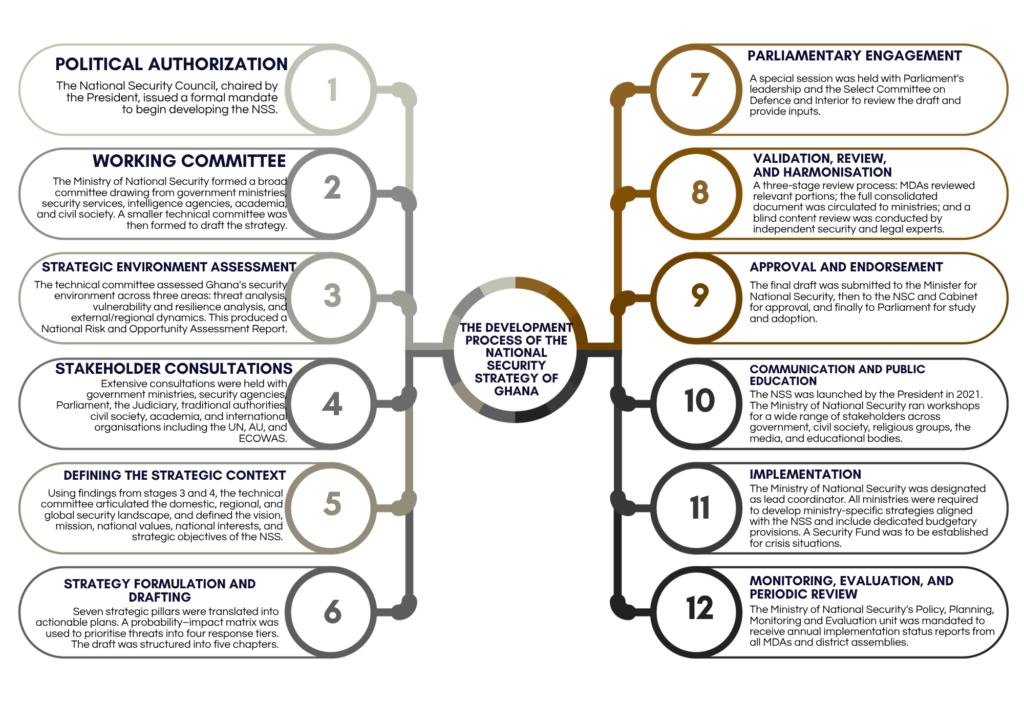
THE DEVELOPMENT PROCESS OF THE NATIONAL SECURITY STRATEY OF GHANA
Stage 1: Political Authorization
The process for the development of the NSS of Ghana began with a formal Mandate from the National Security Council. In the context of Ghana, the National Security Council, chaired by the President is the apex body constitutionally mandated to be responsible for the enactment of policies and the management of matters relating to national security
Stage 2: Establishment of a Working Committee
Following political authorization and a formal mandate from the National Security Council, the Ministry of National Security constituted a working committee to develop the National Security Strategy (NSS). The committee drew representation from the Ministry of National Security, Ministry of Defence, Ministry of Interior, Ministry of Foreign Affairs, the Office of the Attorney General and Ministry for Justice, the Ghana Police Service, the Ghana Armed Forces, the Ghana Immigration Service, the three statutory intelligence agencies, as well as academia and civil society organisations.
The committee was responsible for defining the scope, timelines, methodology, and expected outputs of the NSS process. It reviewed existing policies, including the security components of national development plans, military strategies, and frameworks for preventing and countering violent extremism and terrorism, alongside relevant regional, continental, and international protocols, resolutions, agreements, and commitments, to ensure alignment and coherence.
A smaller technical committee of experts was subsequently formed to draft the strategy. This group conducted consultations with Ministries, Departments, and Agencies across government and periodically engaged the President to seek approval on the draft vision and mission of the NSS.
Stage 3: Strategic Environment Assessment
Without a comprehensive diagnosis of threats, a nation risks designing a National Security Strategy (NSS) that is not fit for purpose. Against this backdrop, the technical committee conducted a thorough assessment of Ghana’s security environment.
The assessment covered three main areas. First, a threat analysis identified key risks, including terrorism, violent extremism, insurgency, transnational organised crime, maritime insecurity, pandemics, and natural disasters. Second, a vulnerability and resilience analysis examined governance capacity, border management gaps, institutional weaknesses, social cohesion challenges, and technological deficits. Third, an analysis of external and regional dynamics considered geopolitical shifts, regional conflicts, cross-border crimes, climate change impacts, and opportunities for cooperation through bilateral and multilateral partnerships.
A key outcome of this process was the production of a National Risk and Opportunity Assessment Report, which provided the evidence base for defining the priorities of the NSS.
Stage 4: Stakeholder Consultations
Extensive stakeholder consultations were undertaken as part of an inclusive process to develop a people-centred National Security Strategy (NSS), reflecting both a whole-of-government and whole-of-society approach to security. The aim was to gather and understand the perspectives of a broad range of actors across governance, security, and community levels.
Participants included key government ministries; Foreign Affairs, Defence, Interior, Finance, Environment, Food and Agriculture, Energy, Gender, and Justice, as well as the Ghana Armed Forces, Ghana Police Service, Ghana Immigration Service, Ghana Prisons Service, Customs Division of the Ghana Revenue Service, and the statutory internal and external intelligence agencies. Parliament and the Judiciary were also engaged to strengthen democratic accountability and anchor the NSS within national, regional, continental, and global legal frameworks.
Additional stakeholders included traditional authorities, civil society organisations, academia, and international multilateral organisations such as the United Nations, African Union, and ECOWAS.
Stage 5: Defining the Strategic Context
Defining the strategic context is a critical step in the development of a National Security Strategy (NSS). The strategic context refers to the broader policy environment within which the NSS is anchored.
In developing Ghana’s NSS, findings from the strategic environment assessment and the extensive stakeholder consultations provided the foundation for articulating this context. Based on this evidence, the technical committee outlined the domestic, regional, and global security landscape, as well as the vision, mission, national values, national interests, and strategic objectives of the NSS.
Key priorities that emerged included sovereignty, territorial integrity, public safety, economic stability, democratic governance, and social cohesion, identified as core national interests for Ghana.
Stage 6: Strategy Formulation and Drafting
At the strategy formulation and drafting stage, the seven pillars of the vision of Ghana’s National Security Strategy (NSS), developed through the strategic context process, were translated into actionable plans.
These pillars focus on:
- Resourcing and strengthening the Military, Intelligence, Security and Law Enforcement capabilities of the State
• Building trust and cooperation between Security Services and local communities
• Leveraging opportunities available to Ghana as a member of ECOWAS, the AU and the UN to strengthen national capacity to prevent and counter violent extremism, terrorism and cybercrime within Ghana’s territorial jurisdiction
• Promoting good governance, human rights, tolerance and peaceful co-existence to reduce conflict and enhance national security and stability
• Developing the human capital of Ghanaians through universal education, skills training and exposure to build entrepreneurship capacity and support the national development agenda
• Pursuing prudent economic, trade and investment policies that strengthen the national economy and create employment and prosperity, with an initial focus on food security, energy and health
• Advancing a progressive and dynamic foreign policy that facilitates cooperation with friendly countries, development partners, and other ECOWAS and AU member states
The strategy formulation process also focused on designing effective responses to the security threats identified during the strategic environment assessment. A risk prioritisation analysis was conducted using a probability–impact matrix, which categorized threats based on the likelihood of occurrence and the potential negative consequences. This approach helped guide and prioritise response efforts.
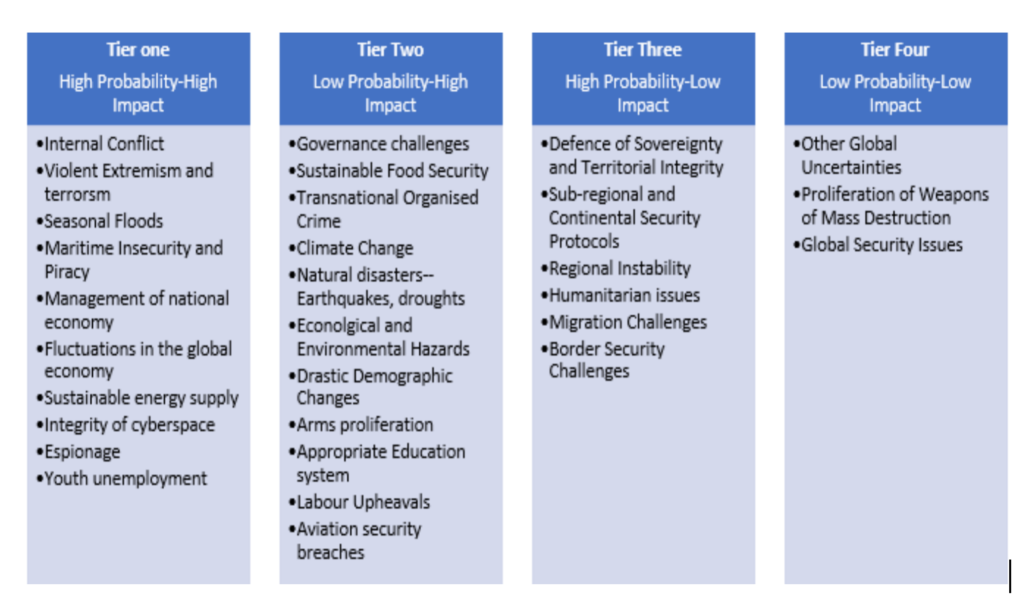
Probability-Impact Matrix of the Security Threats in Ghana. Source: Adopted from the National Security Strategy
Tier 1, Tier 2, Tier 3, and Tier 4 responses were developed based on the probability of occurrence of identified threats. Tier 1 responses address clear and present threats and opportunities that require the highest priority, with active and immediate action. Tier 2 responses focus on major but potential or imminent threats and opportunities, requiring constant monitoring, effective early warning systems, and strengthened resilience mechanisms. Tier 3 responses target persistent but relatively low-impact risks that are unlikely to pose an existential threat in the immediate term and therefore require periodic review at short intervals. Tier 4 responses cover risks that are less probable and less likely to cause harm but still require monitoring and periodic assessment.
To ensure logical flow, the draft strategy was structured into five chapters. Chapter One outlines the strategic context; Chapter Two examines domestic, regional, and global threats, risks, and challenges; Chapter Three presents strategic responses and measures for the protection of Ghana; Chapter Four focuses on safeguarding national cohesion; and Chapter Five details the implementation of the NSS.
Stage 7: Engagement with Parliament
A special session was organised for the leadership of the Parliament of Ghana and the Parliamentary Select Committee on Defence and Interior to review the draft National Security Strategy (NSS) and provide inputs. These engagements ensured that democratic control and legislative oversight were integrated into the process from the outset of the NSS’s development.
Stage 8: Validation, Review and Harmonization
A three-stage approach was adopted in validating and reviewing the draft NSS document. In the first stage of validation and review, the various Ministries, Departments and Agencies (MDAs) received relevant portions of the draft NSS document whose implementation fell within their remit during the initial formulation process. In the second stage, the Ministries received the whole draft document after the reviewed portions of the document had been consolidated and harmonized into a single document by the technical committee with inputs from Parliament and other actors. In the third stage, a blind content review was undertaken by selected high-profile security and legal experts was conducted.
Stage 9: Approval and Endorsement
The final draft NSS document produced after the review and validation process was submitted to the Minister for National Security for onward submission to the National Security Council and Cabinet for review and approval. Upon receiving Cabinet/ Executive approval, the document was submitted to Parliament for study and adoption.
Stage 10: Communication and Public Education
The final National Security Strategy (NSS) was officially launched by the President of Ghana in 2021. Following its launch, the Ministry of National Security, which was tasked with coordinating implementation, initiated an extensive public education and sensitisation programme.
Workshops were organised for a broad range of stakeholders, including the Council of State, the Judiciary, the Executive, the Ghana Bar Association, Civil Society Organisations, religious groups such as the Christian Council and the Ghana Muslim Association, the media, the Trade Union Congress, the Ghana National Association of Teachers, Student Representative Councils, Regional Ministers, and Metropolitan and Municipal Chief Executives, among others.
State Security and Intelligence Agencies were also briefed on the specific roles and responsibilities expected of them in achieving the strategic objectives set out in the NSS.
Stage 11: Implementation of the NSS
The courses of action for implementing the National Security Strategy (NSS) were clearly defined within the strategy. The Ministry of National Security was designated as the lead entity responsible for coordinating implementation. Specific roles and responsibilities were also assigned to all Ministries, which were required to develop Ministry-specific strategies aligned with the overarching NSS and submit them to the Ministry of National Security.
Ministries, Departments and Agencies (MDAs), Metropolitan, Municipal and District Assemblies (MMDAs), as well as Security and Intelligence Agencies, were further directed to include dedicated budgetary provisions within the National Budget to support implementation. In the long term, a Security Fund was to be established by the Ministry of Finance, in consultation with the Ministry of National Security, to finance NSS implementation during crises and emergency situations.
Stage 12: Monitoring, Evaluation and Periodic Review
Monitoring and evaluation were incorporated into the overall implementation framework of the National Security Strategy (NSS). As part of this process, the Ministry of National Security, through its Policy, Planning, Monitoring and Evaluation unit, was mandated to receive annual implementation status reports from the various Ministries, Departments and Agencies (MDAs) and Metropolitan, Municipal and District Assemblies (MMDAs).
ALIGNMENT WITH EXISTING FRAMEWORK FOR THE DEVELOPMENT OF NATIONAL SECURITY STRATEGIES
The African Union Policy Framework for Security Sector Reform encourages Member States to develop a National Security Strategy (NSS) as a key tool for advancing security sector reform. The framework outlines general guidelines for what a long-term NSS vision should include and indicates the processes to be followed in developing an overarching strategy.
Prior to the adoption of the National Security Strategy (NSS), the National Security Council was already established, with its composition and functions provided for as entrenched clauses under Articles 83 and 84 of the 1992 Constitution of Ghana. While both the Knudsen framework and the African Union Policy Framework view an NSS as a key tool for advancing security sector reform, Ghana’s approach framed the development of the NSS primarily as a means of institutional reinforcement, aimed at strengthening the capacities of existing State Security and Intelligence agencies.
Impact of Process on Strategic Outcome
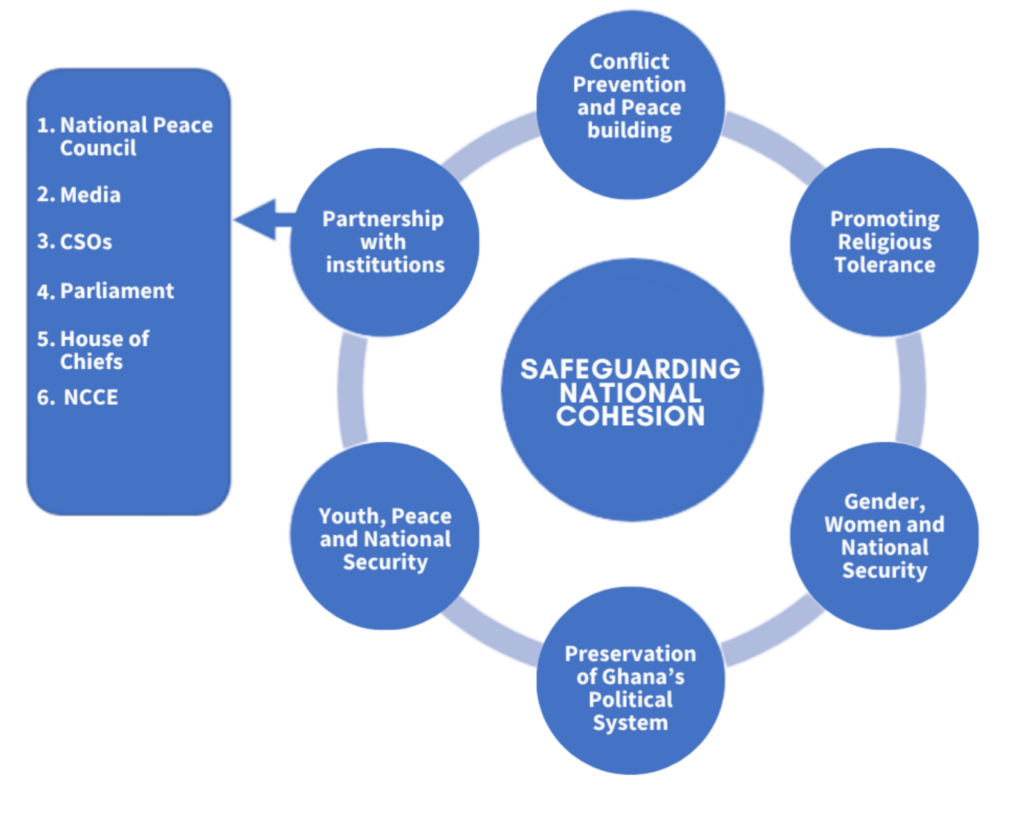
Source: Generated by the Author from the NSS of Ghana, 5th December, 2025.
The National Security Strategy (NSS) of Ghana was designed to encourage active citizen participation in matters related to national security. As part of the strategy formulation process, measures were developed to promote partnerships with key institutions identified as essential to achieving national cohesion and stability.
These stakeholders include the media, the National Peace Council, civil society organisations, the National House of Chiefs, the Council of State, Parliament of Ghana, and the National Commission for Civic Education. Specific roles and responsibilities were assigned to each to support the collective goal of maintaining national stability.
THE DISTINCTIVE FEATURES OF GHANA’S NATIONAL SECURITY STRATEGY
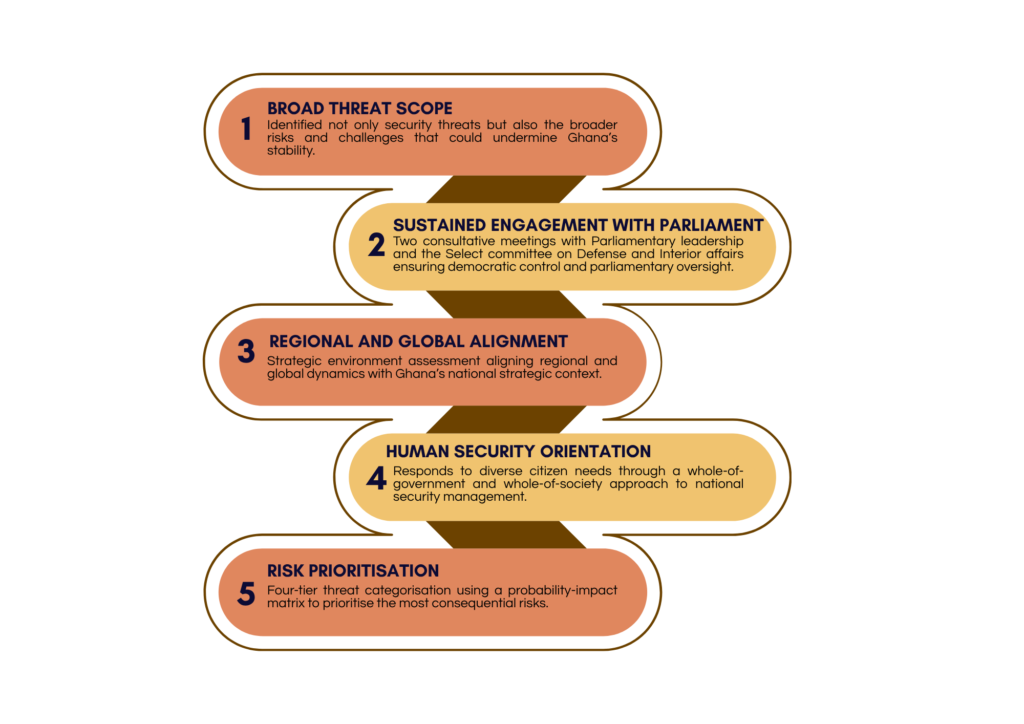
The development process, combined with the novelty of the initiative within the Ghanaian context, gave the National Security Strategy (NSS) several distinctive features that set it apart from similar documents in other countries. These include:
- The process not only identified national security threats but also examined the broader risks and challenges that could undermine Ghana’s stability
• The development incorporated sustained engagement with Parliamentthrough two key consultative meetings; although not involving the entire legislature, contributions from the leadership of Parliament and the Parliamentary Select Committee on Defence and Interior ensured democratic control and parliamentary oversight
• Through the strategic environment assessment conducted by the technical committee, the NSS aligned regional and global dynamics with Ghana’s national strategic context
• The NSS adopts a human security orientation, responding to the diverse needs of citizens and grounding the strategy in a whole-of-government and whole-of-society approach to national security management
• Strategic responses were structured around a four-tier categorisation of threats, enabling prioritisation of the most consequential risks through the use of a probability–impact matrix