

Intelligence
Ghana’s intelligence and national security system has historically evolved from a colonial-era political policing institution into a more legal and regulated, intelligence-led architecture. Today, it carries out activities that address complex threats, including terrorism and violent extremism, cyber and other white-collar crimes, as well as transnational organized crime.
Its contemporary framework is anchored in the Country’s 1992 Constitution, the Security and Intelligence Agencies Act 2020 (Act 1030) and the 2020 National Security Strategy, which together define the institutions, mandates, coordination mechanisms, and oversight arrangements required.
The Historical evolution
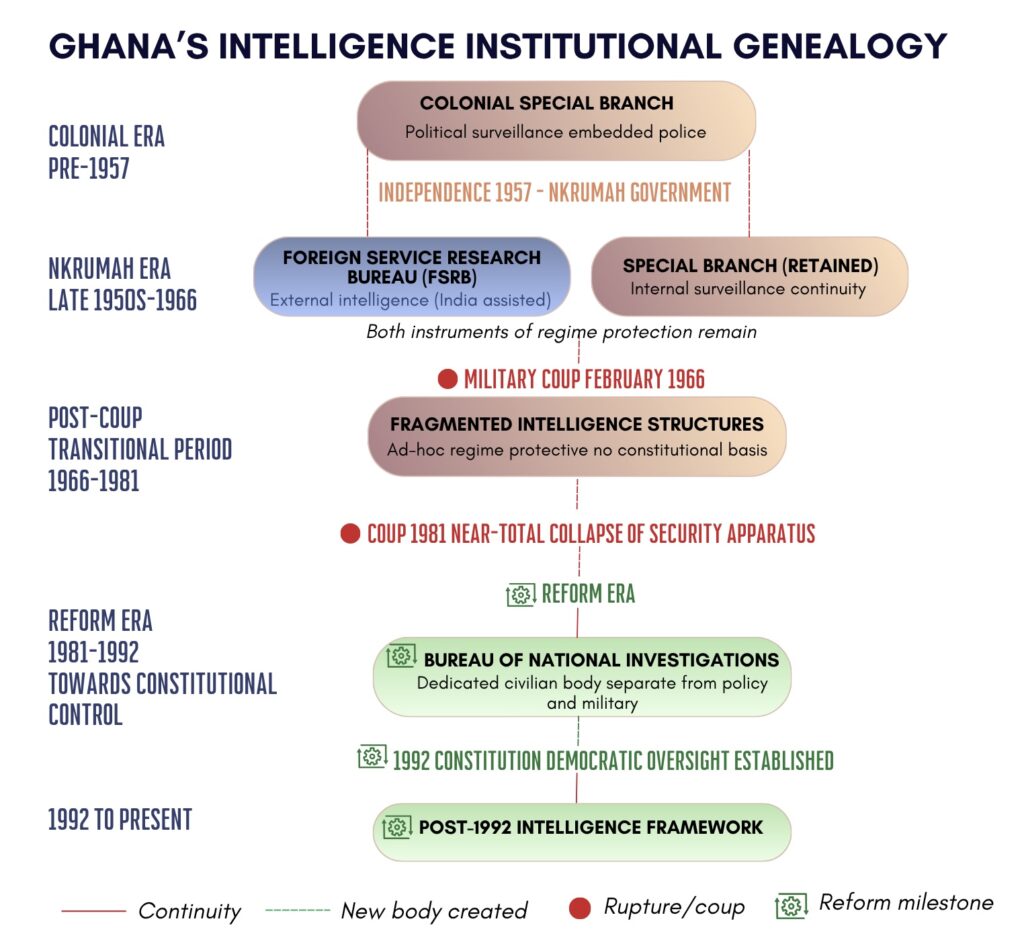
Colonial intelligence in the Gold Coast revolved around a Special Branch-type political surveillance unit embedded in the colonial police force, focused on monitoring nationalist activism rather than providing any kind of neutral national security assessments.
In the late 1950s, when the Kwame Nkrumah government, soon after Independence, turned to India to help build Ghana’s early external and internal intelligence services, they created a Foreign Service Research Bureau and retained the colonial Special Branch as tools of regime protection in a hostile and turbulent political environment that eventually ended in the military coup of February 1966.
But after the coup in 1981 which saw an almost total collapse of the existing security apparatus at the time, reforms gradually began, aimed at building a real Intelligence capability, leading to the establishment of the Bureau of National Investigations (BNI) as a dedicated civilian intelligence body separate from the police and the military, as a means of embedding intelligence structures under constitutional control in 1992.
Thus, Ghana’s intelligence reforms before 1992 were ad hoc, regime-protective, and weakly regulated, whereas reforms after the 1992 Constitution became more law-based, institutionally integrated, and oriented toward democratic oversight and national (not just regime) security.
The Constitutional and legal framework
It was Ghana’s 1992 Constitution that explicitly provided structures for the country’s Security Sector. The Constitution introduced detailed provisions for managing security structures and explicitly included the Directors of External, Internal, and Military Intelligence in the National Security Council, bringing intelligence agencies under constitutional authority and the rule of law.
This stripped the agencies of their former anonymity and required that their activities be conducted within a defined legal and institutional framework instead of by informal executive directives.
To operationalize these constitutional provisions, Ghana enacted the Security and Intelligence Agencies Act 1996 (Act 526) and its replacement, the Security and Intelligence Agencies Act 2020 (Act 1030), to provide statutory mandates for intelligence and security agencies, defining membership and functions of security councils,(District, Regional and National) while providing for Intelligence Agency accountability at Parliament through budgetary control and reporting obligations.
An accountable civilian agency, the Bureau of National Investigations (now National Intelligence Bureau), was consolidated as the main internal intelligence body separate from the police and the military, while the National Security Council Secretariat became the central collating and analysis hub for Internal, External and Military Intelligence Agencies. The post-1992 reforms also emphasized improved training, technology and more rigorous recruitment criteria, gradually professionalizing the services and enabling them to better support policy and crisis situations.
Act 1030 also updated the framework to reflect emerging threats, while formally establishing Regional and District Security Councils as committees of the National Security Council
Structuring Intelligence in Ghana
Ghana’s core intelligence community, therefore, comprises Internal, External, and Military Intelligence agencies, coordinated through the National Security Council and its Secretariat.
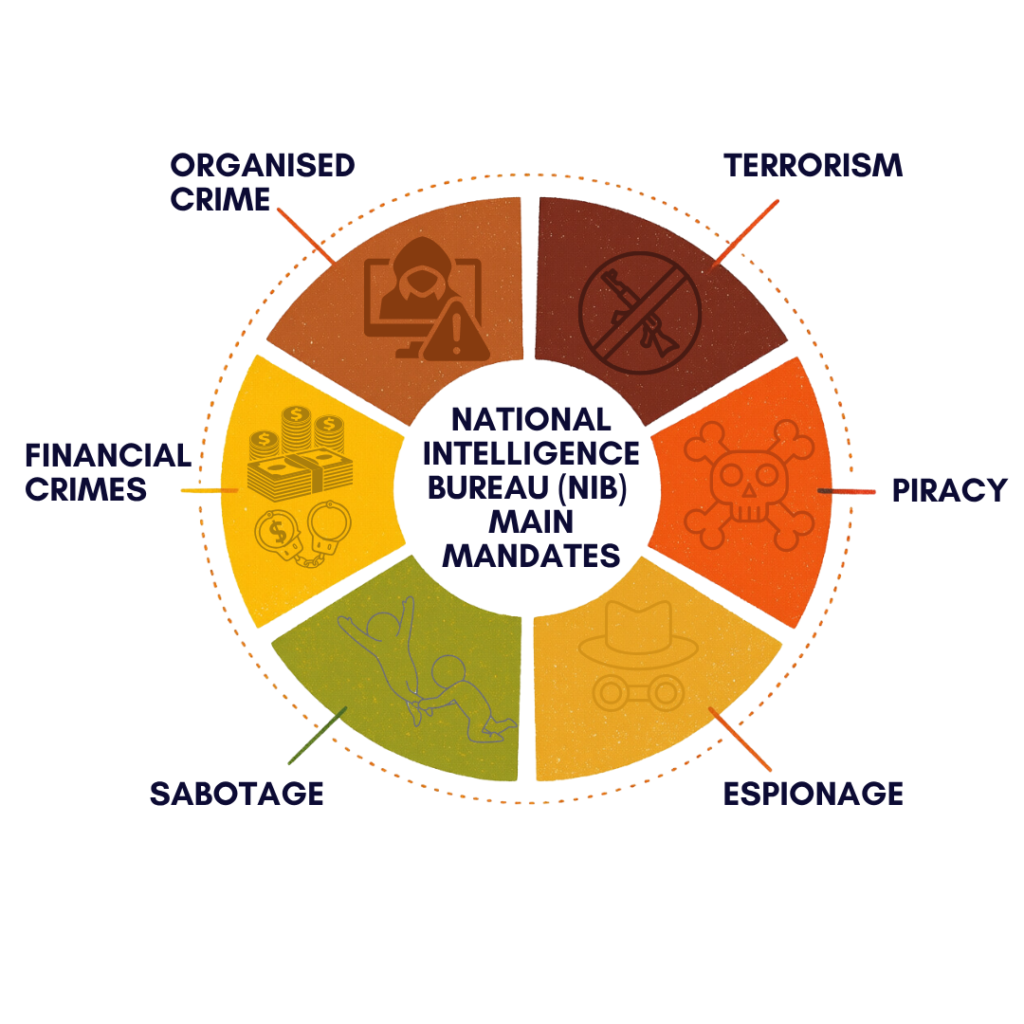
The former BNI, renamed the National Intelligence Bureau (NIB) in 2020, serves as Ghana’s principal domestic civilian intelligence agency. Its mandate covers organized crime, financial crimes, espionage, sabotage, terrorism, piracy, and related threats, and it operates through regional offices across all sixteen regions.
The National Security Council, chaired by the President, functions as the central decision-making body for national security policy, bringing together inputs from the Ghana Armed Forces, the Ghana Police Service, the NIB, and other specialised agencies. Supporting this structure, the National Security Council Secretariat (NSCS) serves as the coordinating hub for crisis management, inter-agency intelligence fusion, and contingency planning, acting as the operational nerve centre of Ghana’s intelligence-led security architecture.
Policy frameworks and strategy
The National Security Strategy of Ghana ( A Secure and Prosperous Ghana, with Regional, Continental and Global Reach and Influence) document, issued in 2020, pursuant to section 24 of Act 1030, consolidates various sectoral policies into a single framework that identifies key threats and sets out the strategic national security objectives of Ghana, focused on sovereignty, territorial integrity, human security and socio-economic stability.
Complementing this, Ghana has adopted the National Framework for Preventing and Countering Violent Extremism and Terrorism (NAFPCVET), which provides for a four-pillar counterterrorism strategy—Prevent, Pre-empt, Protect and Respond (3PR)—with the Ghanaian Intelligence Community placed at the centre of implementation.
These frameworks recognize terrorism, cyber threats, maritime insecurity and organized crime as key risks and explicitly require enhanced intelligence sharing and community engagement to achieve these goals.
Operational dynamics and coordination
Ghana’s current model is described as “intelligence-led,” meaning that security operations, especially in counterterrorism and complex crime, are designed around timely collection, analysis and dissemination of intelligence rather than a reactive force deployment, after the fact.
Thus, NSCS’s role as an all-source fusion center, especially the role of its Secretariat in integrating military, police, border, financial, and external intelligence to produce strategic and operational assessments for decision-makers at all levels, is central to this effort.
At the same time, Regional and District Security Councils, established under Act 1030, are expected to feed localized information upward, providing early-warning on communal conflicts, chieftaincy disputes, and other internal tensions that can escalate into broader security crises.
This multi-layered structure aims to bridge the gap between national-level strategy and community-level realities.