

Civil Society and PCVE
Preventing and Countering Violent Extremism (PCVE) has become an increasing national and regional security concern across West Africa. While Ghana has not experienced a major direct attack, growing threats in the Sahel highlight the need for proactive and locally rooted resilience measures. Civil Society Organisations (CSOs) play a key bridging role between communities and the state by delivering services, shaping narratives, providing early warning, and leading interventions that strengthen prevention, rehabilitation, community resilience, social cohesion, and the use of counter-narratives in target communities. They are therefore central to efforts directed at preventing and countering violent extremism (and terrorism) in the region.
OVER CONCENTRATION ON BORDERS AND EXTERNAL THREATS
PCVE approaches in Ghana are largely shaped by the perception that violent extremism originates from external sources. This threat framing has directed most interventions toward border security, with emphasis on preventing infiltration and addressing vulnerabilities at entry points and border communities. This typifies a traditional state-centric approach to security. The tendency to concentrate excessively on border communities risks overlooking vulnerabilities in inner cities. Several examples illustrate this pattern. The first deadly attacks in Burkina Faso in January 2016 and Côte d’Ivoire in March 2016 occurred not in border areas but in the centres of Ouagadougou and Abidjan, respectively. Similarly, since 2015, when Ghana began recognising the potential threat of violent extremism, most individuals who have travelled or attempted to travel to join ISIS or JNIM have come from inner cities rather than border communities. For instance, Nazir Alema Nortey, the first Ghanaian to publicly declare allegiance to ISIS and announce his departure to Syria, was raised in Accra. Baba Adams, an ISIS recruit who was dissuaded a day before his planned departure, is a native of Wulensi in the Nanumba South District of the Northern Region. Approximately thirteen others who either left or attempted to leave Ghana to fight with terrorist groups also originated from inner cities, including Accra, Kumasi, Karaga, Tamale, and Wulensi.
In the last 5 years, Ghana’s approach to PCVE has been significantly disproportionate in favor of combat measures. This is evidenced by the Operation Conquered Fist, Eagle Claw, Operation Koundandglou I, II, III and IV. However, years of advocacy by Civil Society Organisations (CSOs) have contributed to greater state recognition of the role of civil society in security, security governance, and peacebuilding. This has led to a commitment to establish a CSO desk at the National Security Secretariat to strengthen coordination and collaboration between the two.
LEGAL AND POLICY ENVIRONMENT
Ghana’s PCVE space consists of legal frameworks, institutional arrangements, and local governance and security initiatives. Under the legal response, frameworks such as the Anti-Terrorism Act of 2008 (Act 762), the 2014 amendment to the Anti-Money Laundering Act of 2008 (Act 749), and the Organized Crime Act of 2010, which prohibit the financing, recruitment, and support of terrorist activities.
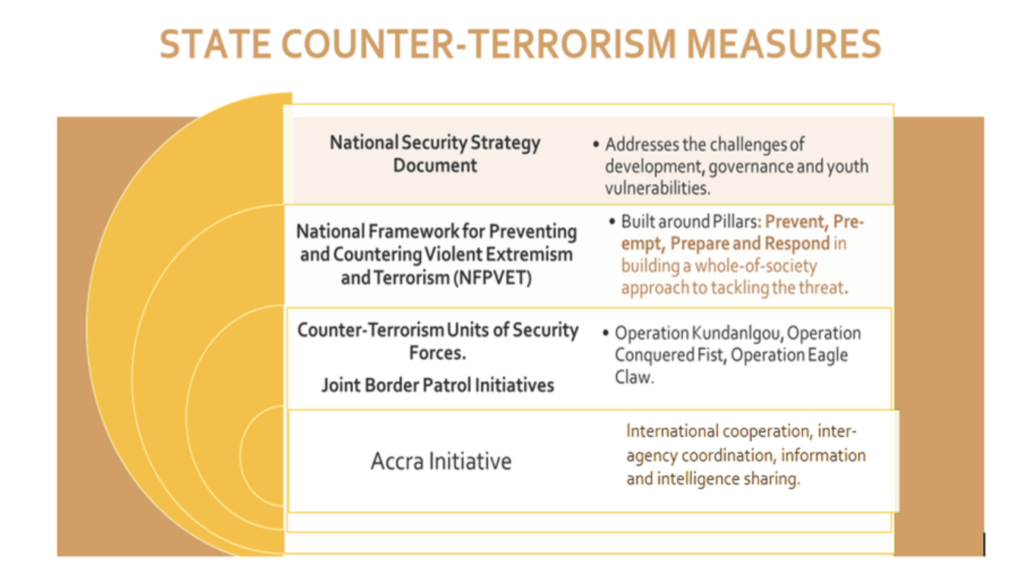
Ghana’s National Security Strategy, adopted in 2021, is complemented by the National Framework for Preventing and Countering Violent Extremism and Terrorism (NAFPCVET), which is designed to address violent extremism and terrorism in the country. The NAFPCVET identifies relevant stakeholders and clearly outlines the context, coordination structure, and roles and responsibilities.
Within this framework, the PREVENT pillar—alongside PRE-EMPT, PROTECT, and RESPOND—assigns a leading role to CSOs in education, awareness creation, and capacity-building for local community actors to strengthen resilience against radicalisation and recruitment. Additional reference instruments for PCVE efforts include the Cyber Security Act of 2020 (Act 1038), the Anti-Terrorism Act of 2008 (Act 762), and the dictates of the Accra Initiative.
At the operational level, the Accra Initiative has undertaken various measures to strengthen border security. Counter-terrorism operations and exercises, such as “Operation Conquered Fist,” “Exercise Eagle Claw 2020,” and Operation Koudanlgou I, II, III, and IV, have been conducted to deter threats, enhance the capacity of security forces to prevent potential attacks, and address transnational crime in border regions.
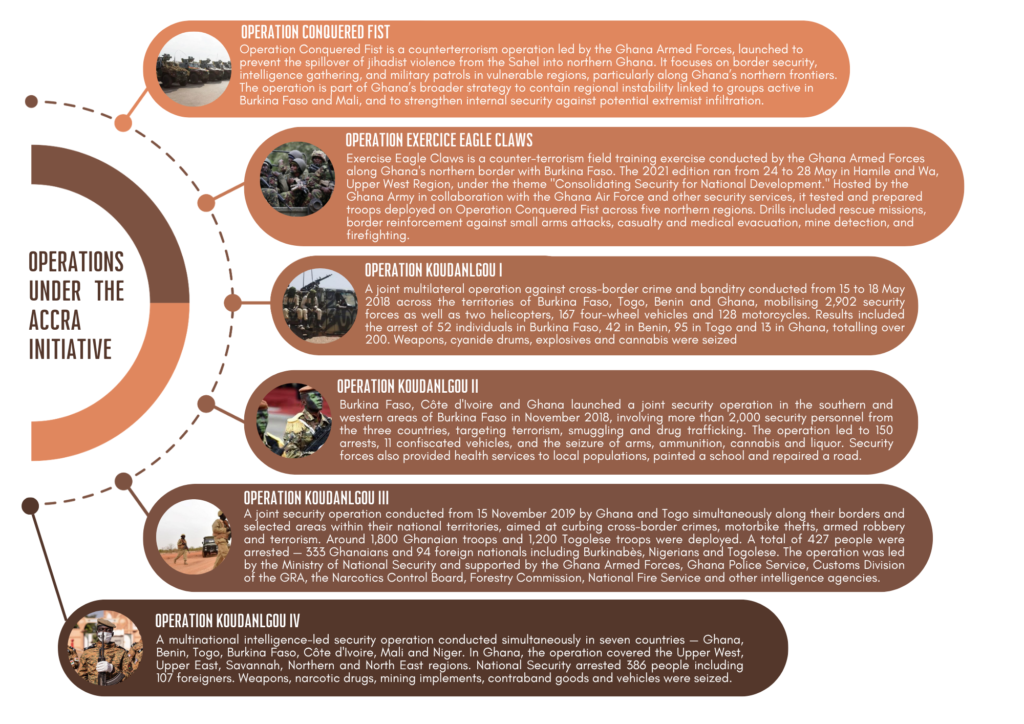
In addition, the provision of social services, including health screenings, borehole drilling, and the construction of bridges, in vulnerable border communities remains important. The combination of these counter-terrorism efforts and the delivery of essential services in remote and at-risk areas has helped build a strong and resilient front that has likely deterred potential attacks in Ghana.
Furthermore, as well as the Ministry of Security, Ghana’s national security sector comprises two other ministries, the Ministry of the Interior and the Ministry of Defence, alongside more than 22 national-level agencies tasked with addressing security vulnerabilities. These include the National Centre for Coordination of Early Warning and Response Mechanism (NCCRM), National Commission for Civic Education (NCCE), National Commission for Small Arms and Light Weapons, the National Cybersecurity Authority, National Disaster Management Organization (NADMO), Ghana Immigration Service (GIS), Ghana Boundary Commission, Economic and Organized Crime Office (EOCO), among others. This institutional landscape makes competition, duplication of roles, and siloed approaches difficult to avoid. But a bit of clarity and history is needed here to explain the context within which these issues operated.
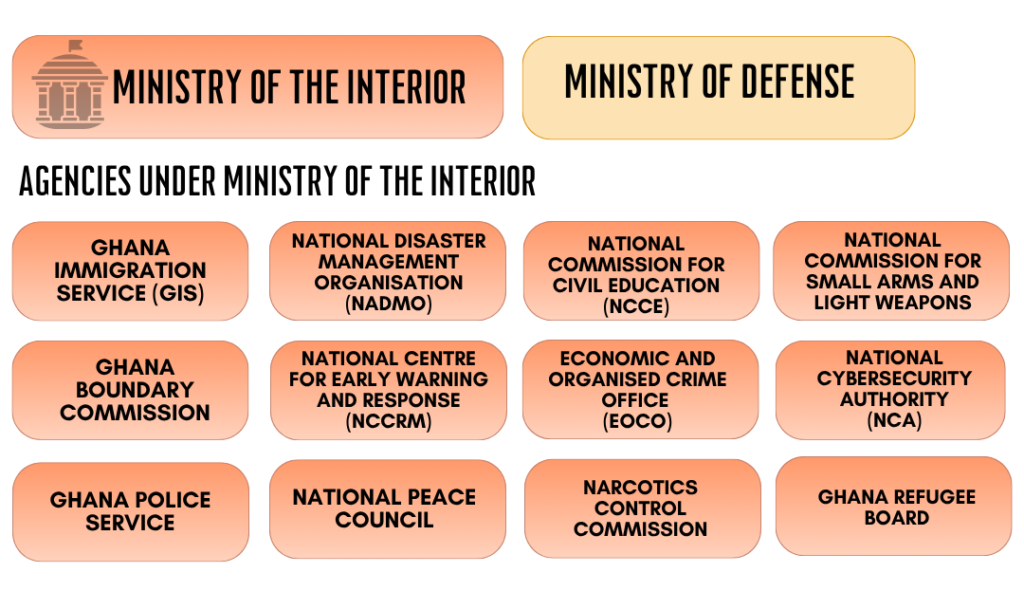
From 2017 to 2025, the ruling New Patriotic Party established the Ministry of National Security. This ministry played a key role in general security issues. However, following the National Democratic Congress’ victory in the 2024 general elections, the Ministry of National Security was merged into the Ministry of the Interior
Given the enormity of the problem of violent extremism and terrorism, it is not surprising that multiple efforts have been put in place to address Preventing and Countering Violent Extremism (PCVE). For instance, the World Bank-funded Gulf of Guinea Social Cohesion (SOCO) project is the largest regional PCVE initiative, supported by an approximately US$450 million credit facility for projects aimed at preventing conflict spillover from the Sahel and strengthening socio-economic resilience against extremism. Ghana’s share of the funding amounts to US$150 million and, since 2022, has been implemented across six regions in Northern Ghana.
REGIONAL LEVEL INITIATIVES AND APPROACHES
The security emergency in the region has prompted the rapid development of national frameworks and initiatives across West Africa. Ghana’s NAFPCVET is often cited for its comprehensiveness. Similarly, Benin and Togo have developed national strategies that create space for “whole-of-society” approaches. Both Benin’s High Level Committee for the Fight Against Terrorism and Insecurity at Borders (CLTIF) and Togo’s Inter-Ministerial Committee for the Prevention and Fight Against Violent Extremism (CIPLEV) emphasize inclusion.
These bodies bring together national-level actors and a broad range of stakeholders, including non-state actors, and are chaired by the Minister for the Interior. They have also been decentralised to incorporate local-level actors through committees responsible for monitoring and ensuring the implementation of extremism-related interventions, with the aim of preventing spillover into other parts of the country.
Research and Capacity Building
- WANEP
In 2020, WANEP, in collaboration with ELVA and ECOWAS, conducted research on the spillover of violent extremist movements into littoral states in West Africa, focusing on Ghana, Côte d’Ivoire, Togo, and Benin. The study identified significant community-level drivers of radicalization toward violent extremism in Ghana.
- WACCE
WACCE commenced its first major PCVE research on the vulnerability of Muslim youth in tertiary educational institutions to radicalization, in collaboration with the British High Commission (BHC), during the 2018–2019 period. WACCE’s report, titled The Threat of Violent Extremism to Coastal States: Ghana’s Exposure to Violent Extremism (2022), highlights the magnitude and nature of the threat facing Ghana.
- PROMEDIATION
Promediation’s studies outline the drivers of, and Ghana’s increasing vulnerability to, violent extremism. They highlight the spillover effects of the security situation in the Sahel, porous borders, and local dynamics along the country’s northern frontiers.
Policy Dialogues and Engagements
The complexity and evolving nature of PCVE implies that only a small number of CSOs have built the requisite capacity to initiate PCVE policy engagements. For instance, STAR-Ghana has instituted an annual Regional Security Dialogue that brings together security chiefs and heads of government institutions to share relevant information and engage critically with it to inform policy action. The discussions have largely focused on strengthening institutional structures and capacities to address chieftaincy, ethnic, and land disputes, as well as the challenges of marginalization faced by ethnic Fulbes and their integration.
The collapse of Accra Initiative and the strained relations between ECOWAS and the AES countries leaves a major collaboration vacuum that undermines the regional collaborative efforts. It is believed, however, that Ghana’s creation of the Office of the Special Envoy to the Sahel has summoned a new injection of momentum for ECOWAS-AES collaboration. It is the government of Ghana’s attempt to reestablish trust and goodwill between ECOWAS and the AES countries.
GAPS AND CHALLENGES
Stakeholder Mapping
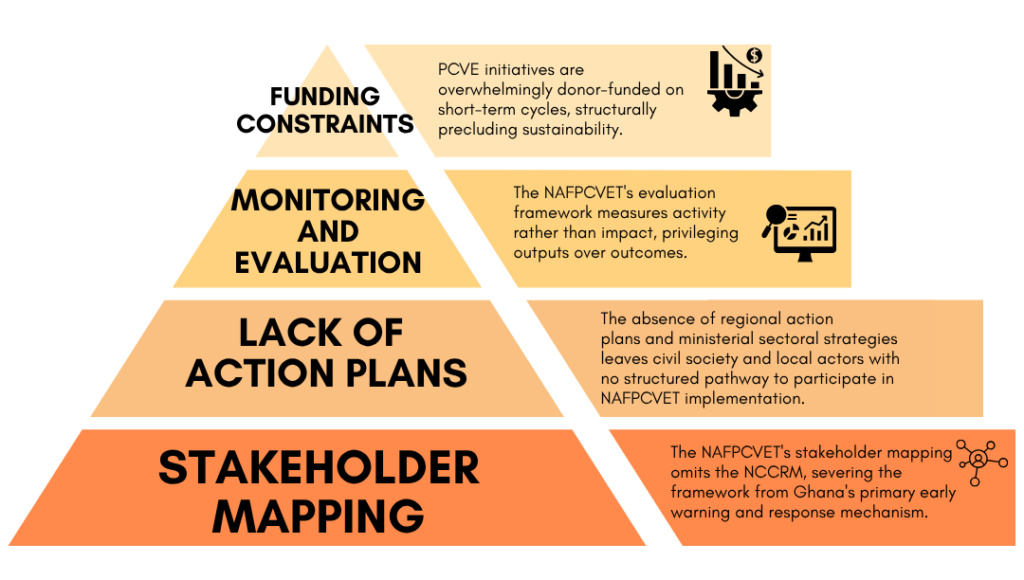
Even though the NAFPCVET appropriately features all relevant institutions, it ignores an important agency such as the National Centre for Coordination of Early Warning and Response Mechanism (NCCRM). Whether this has been an oversight or by deliberate action, it is a fundamental error that should be revisited. NCCRM is a product of ECOWAS regional security efforts and serves as Ghana’s central hub for monitoring, analysing, and reacting to potential security challenges whilst ensuring a coordinated national response.
As in various other West African nations, NCCRM was set up under ECOWAS’s framework to identify security threats in West Africa in ways that bridge the gap between warning and response by focusing on national security and human security through strategic research, inter-agency collaboration, and community engagement. It operates under Ghana’s President, coordinating with national bodies and ECOWAS to ensure proactive action against emerging regional crise.
Lack of Action Plans
The NAFPCVET implementation requires action plans at regional levels to allow CS and local level actors to participate in its implementation. In addition, Ministries lack sectoral plans on PCVE.
Monitoring and Evaluation
Evaluation is overly focused on the number (participants, beneficiaries, communities, interventions or activities) rather than on the impact of the interventions. It emphasizes output over outcomes.
Funding Constraints
Most PCVE initiatives are donor-funded and most funding programs are for short term interventions which does not allow project sustainability.